




*Umahi faults verdict, says he remains Ebonyi Gov
* Court can’t stop NASS from lawmaking – Senate President
*Ozekhome: No court can remove Gov over defection
Controversy is now trailing the pronouncement of Justice Iyang Ekwo of the Federal High Court in Abuja, who ordered the removal Ebonyi State Governor David Umahi, his Deputy, Dr Kelechi Igwe and 17 members of the State House of Assembly over their unlawful defection from the Peoples Democratic Party (PDP) from the All Progressives Congress (APC).
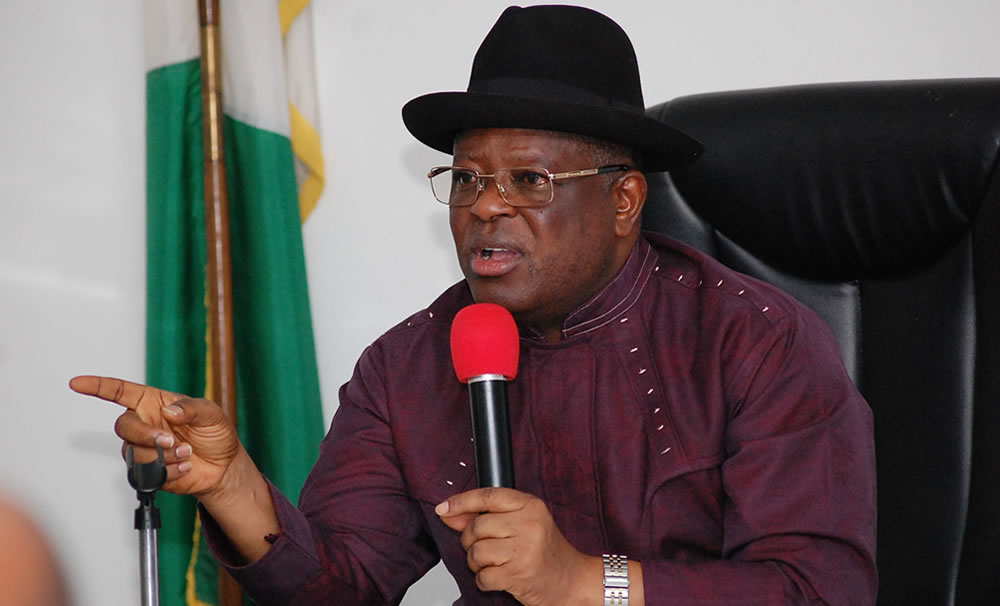
But Governor Umahi in his swift reaction, called on the people of Ebonyi State to remain calm saying that he remains the Governor of the State.
Umahi, who spoke with journalists in his office at the new Government House, Abakaliki, also described the court verdict as “jungle justice that was purchased”.
He added that the verdict was not a good development for the judiciary, saying that he has petitioned the National Judicial Council (NJC) over the conduct of the judge.
Governor Umahi, who described the judgment as embarrassing, alleged that the presiding judge was influenced to deliver the judgment against him.
He noted that there is no provision in the 1999 Constitution (as amended) whereby a serving Governor or his Deputy could be removed on account of defection to another political party.
He explained it is only through death, resignation or Impeachment by the state House of Assembly that a serving Governor and his Deputy could be removed from office.
Justice Ekwo had on Tuesday sacked Governor Umahi and his Deputy, Igwe, from office and directed that they should not parade themselves in like manner.
Theideal recalls that it was the same judge that granted the ex-parte application of the PDP, restraining the National Assembly from tampering with the Electoral Act.
But the Senate President, Ahmad Lawan, has disclosed that no court can stop lawmakers from performing their statutory role on lawmaking.
Meanwhile, Ebonyi State Chapter of the APC has reacted to the court verdict, saying that it is a “disturbance to democracy” in the state.
The APC Publicity Secretary Mr Simbad Chidi, who reacted shortly after the court verdict, said the verdict was unacceptable, adding that the APC will appeal against the judgment.
He said, “Today’s ruling in Abuja cannot overrule the State High Court that upheld his defection to APC already. The ruling is unacceptable.
But the Senate President, Ahmad Lawan, has said that the ruling by the Federal High Court in Abuja, would not stop the National Assembly from amending the Electoral Act.
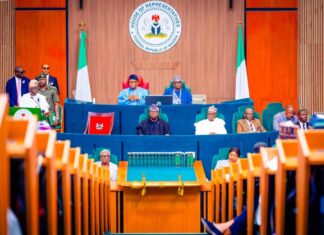
The Senate President, while reacting to the ruling by the Federal High Court after the Electoral Act Amendment Bill scaled first reading during plenary, on Tuesday, said same ruling violated the provisions of the 1999 Constitution (as amended) on Separation of Powers.
Lawan said, “I find it necessary to talk to this at this point, because our governance system is based on the Presidential System of Government where there is clear cut separation and exercise of powers.
“The Judiciary, under no circumstance, cannot stop the National Assembly from performing its legislative duties.
“We know what our due processes are, just like we wouldn’t venture into what the Judiciary does, it should also understand that we have our processes.
“If the President writes to the National Assembly to request for an amendment, that is within his competence, and it is for the National Assembly to decide whether it agrees with the request of Mr. President or not.
“But to say that we cannot consider it, is to ask for what is not there to be given. I believe that members of this National Assembly know their work and will do what is right.
“This is due process, we are not doing anything outside the law, whether it is Mr. President or any Nigerian who feels very strongly about an amendment, this National Assembly is ready to take in and consider.
“It is within our exclusive right to consider whatever request we receive from Nigerians, whether through the Executive arm of government or through our colleagues – private members’ bill.”
Senator Gabriel Suswam (PDP, Benue), while rising under a point of order, faulted the ruling of the Federal Court.
He said, “I agree with what you have said, the court cannot stop us from making laws. The problem with the letter sent to us by the President was that there is a part of it that interpreted the law we made.
“I think that is the only part that the court can act on, because he (President Buhari) said that the law we (National Assembly) made is ultra vires the Constitution, which is not his responsibility, and, I think, to that extent, the court can comment on that and not on the fact that we are making laws”.
Senator Ike Ekweremadu (PDP, Enugu) while citing Order 52 (5) of the Senate Standing Order, called on the Senate to abide by the court ruling.
He said, “When we were waiting for the President to assent to the Electoral Act, some of us made a suggestion we believed would help, namely that the President would sign and then we would commit ourselves to amending that section.
“Mr. President, I also offered to help in redrafting it, now we have a situation where they’ve told us there’s a judicial restriction on us to do that.
“Mr. President, I agree with you entirely, but the principle as all the lawyers here know, is that if there is a court order, no matter how wrong it is, our responsibility as individuals and citizens is to respect it. The argument you have raised is what we are going to raise in response.”
The Senate President, while giving his ruling to the Order raised by Ekweremadu, said, “This has nothing to do with what happens in the court.”
But Ekweremadu advised the National Assembly to discharge the court order.
He said, “I think the argument you’ve raised is valid, but this point is what we have to present in court to discharge that order.
“We cannot sit and appeal on a matter that has already been given an order in court. I think we should exercise caution in siting a judgment over a matter that an order has been given.
“What we should do is to brief our lawyers to go and discharge the order, instead of sitting here and disobeying court order, is is not good for us and our system, that is calling for anarchy.”
Responding, Lawan said, “My opinion about anarchy is when either arm of government decides to go into the exclusive preserve of the other.
“If the Judiciary wants to come into the Legislature to decide when we sit and when we don’t, then that’s anarchy.
“If the Judiciary would simply say we are not to consider this and that, and we obey those kind of rulings, that is anarchy, because it is emasculating the legislature and that is not supposed to be .
“We will continue with what we are supposed to do because that is our calling. We are just advising that the Judiciary should please help us develop this democracy, because this arm of government is the least developed and if we allow these kinds of rulings, we may end up going back 23 years ago.
“I believe that what we are saying is the same, but we are emphasising that that judicial pronouncement will not stop us from doing what is right and our work here.”
No court has power to remove defecting governor – Ozekhome
Meanwhile, a legal luminary and human rights activist, Chief Mike Ozekhome (SAN), has said that the judgment is shredded of all legal and factual details, saying that the verdict cannot stand the acid test of constitutionalism nor pass the scrutiny of appellate courts.
According to him, the tenure of office of a Governor and his Deputy are constitutional matters.
Faulting section 221 of the 1999 Constitution cited by Justice Ekwo in his vwe, Ozekhome said, the section merely prohibits political activities by certain associations which are not political parties from canvassing for votes or contributing to elections expenses of any candidate at any election.
A statement personally signed by Ozekhome reads in part; “The Jurist’s learned attention was not drawn to appellate decisions on this type of matter, which under the doctrine of stare decisis and judicial precedent, he ought to have followed meticulously. He may also not have been availed of the clear provisions of sections 180 and 188 of the 1999 Constitution.
“It is not only the registered voters of a political party that cast their votes for a President, Vice President, Governor or Deputy Governor. Many non-politically partisan persons also vote; just like opposition party members who may prefer a particular candidate even though not in their party. It is therefore not correct to hold that votes scored by a candidates belong to a political party and therefore not transferable.
“The courts have since gone over the era of Amaechi V. INEC, where the Supreme Court had held that votes cast in an election belong to a political party. Section 141 of the Electoral Act, 2010, has altered that section, by providing that for a candidate to become Governor, he must have participated at all stages of the election. This includes primaries and the general governorship election.
“The appellate courts have since held again and again that votes cast in an election belong to a live candidate, and not the political party which merely serves as a vehicle that enthrones candidates.
“The Judge in his Judgment had agreed with the PDP which relied on sections 221, 177(c), 106(d) and 65 (2) (b) of the Constitution to substantiate its argument that votes belong to the political parties; and it is impossible for candidates to exist without a political party. The case of NGIGE V. AKUNYILI (2012) 15 NWLR (PT.1323) 343 @ 357-376, which came much later overrule this position. The court held in that case that:
“…It is my considered view that the Appellant in relying on the provision quoted above (section 211 of the Constitution), has conveniently lost sight of the underlined words which show that a political party canvasses for votes on behalf of the candidate. In other words that a political party is nothing more than an agent of the candidate in gathering votes for an election. It is my further view that is against the backdrop of this, that the Electoral Act (Supra) requires the candidate (and not the party of the candidate) that has the highest number of votes at an election to be declared as the winner of the said election and further provides for the means of challenging the return of the candidate (and not his political party…”(Emphasis supplied).
“I therefore most respectfully submit (as held by appellate courts) that a political party is merely a vehicle in which a candidate can ride to contest an election and nothing more.
“The votes belong to the candidate and not the political party. The political party ceases to have any considerable relevance or insolence over a person that has won an election and has been sworn in as a legislator, Governor or President of the entire people, who are far larger than a mere political party.
“The case against Umahi and his Deputy were in their personal capacities as human beings who had defected from the PDP to the APC.
“Consequently, no civil or criminal proceedings could ever sustain against this set of persons, whilst still holding office. Indeed, in the words of section 308 (1), “No civil or criminal proceedings shall be instituted or continued against a person to whom this section applies during his period in office”. More significantly, “no process of any court requiring or compelling the appearance of a person to whom this section applies, shall be applied for or issued”.
” I humbly submit that a Governor already sworn in cannot be removed by the Federal High Court through an Originating Summons. It will surely be set aside on appeal. Mark my words”.
Lawyers express divergent views
But lawyers have expressed divergent views on the court judgment.
While some condemned the verdict, others argued that the pronouncement is line with the 1999 Constitution and the Electoral Act.
An Abuja-based lawyer, Mr Victor Oziegbe, has commended the judgment of the court, saying that the verdict is in line with the position of the law.
Oziegbe said, “While I sadly commend the judgment of Justice Ekwo of the Federal High Court on the sacking of Ebonyi State Governor and his Deputy, in the face of today’s legal reality, that is the position of the law.
“However, I’m undoubtedly certain, appeal is beaming to challenge the judgment at the appellate court. It is interesting that Section 221 of 1999 Constitution is instrumental to this epic decision. It says: No association, other than a political party, shall canvass for votes for any candidate of any political party. It means a political party owns votes during election and not the candidate.
“In the case of Gov. Umahi, it was not as if he contested an election or there was election when he crossed, rather he defected to another political party when his tenure as a Governor is still running on the platform of the party upon which he became a Governor , and defected to another party that lost an election during the contest upon which he emerged as a Governor. Respectfully, this sounds okay and logical in the face of native intelligence.
“Now, may we be bold to look at section 180 (1) and (2) of the 1999 Constitution. How or circumstances a Governor or deputy may be removed from office as encapsulates therein. It is upon the occurrence of any of the events mentioned therein that a Governor may be removed from office. Sadly, cross carpeting or decamping is not mentioned.
“I make bold to say it is long over due for our legislature to perform their constitutional responsibility in taming ever reoccurring cross carpeting among our politicians. We also need to encourage the Bench for judicial activism, if we are to develop our electoral legal jurisprudence”.
Another lawyer, Lawrence Uche, said, “The judgment is a true reflection of the Constitution and Electoral Act. The governor unlawfully defected from the PDP that sponsored him in the 2015 and 2019 elections.
“The court victory is a vindication of our constitution and it will go a long way in checking the excesses of our politicians who jump from one political party to another without any reasonable cause.”
But another lawyer, Bar Godwin Onwe, said that the governor has a right of appeal and would remain the governor until the last appeal was heard on the matter by the Supreme Court.
He said, “Though the Federal High Court has sacked the governor by its pronouncement. However, Umahi remains the governor of Ebonyi State because he has the right of appeal even up to the Supreme Court”.