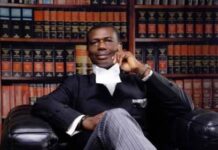





Professor Fidelis Oditah’s recent interactive discussion on a wide range of issues on Arise News, are quite engaging. As a Senior Advocate of Nigeria, SAN and an international legal mind, his views on national issues cannot be disregarded. Benjamin Disraeli, former Prime Minister of the United Kingdom once said, “with words we govern men”. Thus, Oditah’ s words are important and cannot be dismissed as empty effusion lacking weight or impact.
However, the learned Professor’s submission on what he called the Economic and Financial Crimes Commission, EFCC’s three fundamental problems are, to say the least, prejudicial, unfounded and misleading. First, Oditah stated that “The EFCC is often being used for settling many scores. Some are political scores, some are social scores. So, you could run away from your girlfriend and the girlfriend goes to the EFCC and the EFCC could ask you questions(sic). What has that got to do with economic crimes? That is blatant abuse of power”(sic).
How on earth will this kind of a scenario painted by the learned silk hold water? The simplest argument against this kind of effusion is to challenge Oditah to provide proofs of such banality. We all know that this just an idle talk because the EFCC is a serious- minded law enforcement agency. The only worrisome aspect of such a talk is that it betrays an embarrassing lack of grasp of what the EFCC’s focus is.
This issue of appropriate and proper focusing of the mandate of the EFCC has been a central pivot of the three- pronged agenda of the Executive Chairman of the EFCC, Mr. Ola Olukoyede. In the full glare of the entire world, while addressing members of the National Assembly in October 2023, Olukoyede stated that the focus of every fight against corruption was to stimulate growth in the economy.
The second “ fundamental problem of the EFCC”, according to Oditah is that “The EFCC has abandoned its mandate and reduce itself to a debt- collection agency, notwithstanding the numerous court decisions saying the EFCC must stay within the narrow confines of financial and economic crimes. The EFCC has gone out for debt recovery”.
In foreign currencies, recoveries of the Commission in the one year of Olukoyede’s leadership are: $105,423,190.39 (One Hundred and Five Million, Four Hundred and Twenty-Three Thousand, One Hundred and Ninety Dollars, Thirty-Nine Cents); £ 53,133.64 (Fifty-Three Thousand, One Hundred and Thirty-Three Pounds, Sixty-Four Pence; €172,547.10 (One Hundred and Seventy-Two Thousand, Five Hundred and Forty-Seven Euros, Ten Cents) and many others.
Going by the quantum of these recoveries, not to talk of real estate recovered all over the country, including shares acquired with proceeds of crime in blue- chip companies, it is simply preposterous to reduce and ridicule asset recoveries to debt recovery. Professor Oditah owes the EFCC and the entire nation unconditional apology in this regard. Just two days ago, a Federal High Court sitting in Lagos granted final forfeitures of over $2million and seven princely properties in choice areas of Lagos to the Federal Government. The assets are proceeds of crime traced to a former governor of Central Bank of Nigeria, CBN. Do such recoveries fall into the category of debt recovery insinuation of Oditah?
The third issue Odikah raised against the EFCC, like the earlier issues, again, lacks any firm ground of substance. Hear him: “The EFCC itself, a number of officers are more corrupt than those they are chasing. So, you remember what happened to Mr Bawa, Mr Matawalle, when Mr Matawalle finished his tenure as governor of Zamfara state and he said he was invited by Mr Bawa to bring $2million so as not to be investigated. The EFCC itself has become a corrupt organisation which needs to be completely disbanded and a new body set up . The EFCC has the resources. It does not have the ethics. The EFCC majors on minor issues, catching students and showing them as cyber criminals and so it says, it procured 1000 convictions and when you look at them they are people who have defrauded people of 20 or 22 dollars. That’s not the mandate. That’s the periphery. The central mandate is to ensure that the resources which are put in the hands of states are used by the states and that’s where the EFCC”
Going through all these trumped- up claims, it is obvious that Oditah has elected to totally launch unwarranted verbal war against the Commission and its officers. How many officers of the EFCC have been tainted with corruption allegations? Is it acceptable to use the “ sins” of very few elements in a community to paint and taint it as a community of sinners? It should be noted that there is no law enforcement agency in the world that is not vulnerable to corrupt officers.
It is worrisome that a Professor of the reputation and exposure of Oditah could dismiss the Commission’s onslaught against internet fraudsters as an unserious engagement. The damages this genre of fraudsters are causing the nation is untold. A crime that has a projection of $10.6trillion loss to the whole world in 2025 and Nigeria lost more than $500million in 2022 alone, is what Oditah derisively lampooned the EFCC about. We have cause to be worried that those who ought to know better are either playing the Ostrich or advertising their ignorance of a major malaise confronting the nation.
There is no denying the fact that the respected professor goofed in all his comments about the EFCC and his views are not reflective of the realities on ground concerning the anti- corruption fight of the government.
On a final note, we enjoin Prof Oditah to get himself familiar with the works of the Commission and lend his expertise and rich experience to the nation for a more robust and fully- integrated war against corruption. We also want to advise the fourth estate of the realm not to allow their platforms to be used to cast unfounded aspersions on the good works of the EFCC. The Commission is not averse to meaningful contributions and advice from well- meaning and reform- minded Nigerians to strengthen our processes and procedures as we continue this crusade.
*Oyewale, the Head of Media & Publicity of the EFCC, contributes this piece from Abuja