





*Demand reversal of emergency rule in Rivers
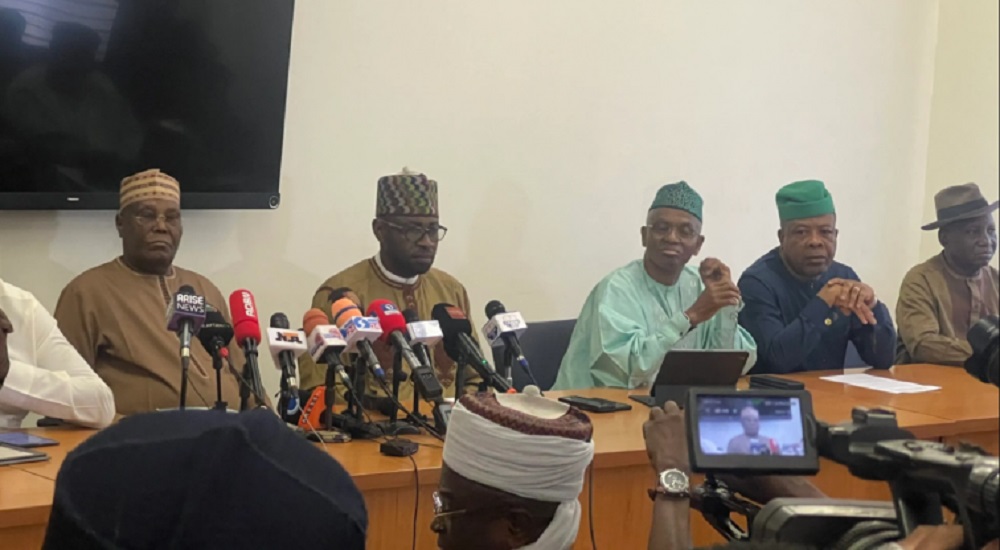
Key opposition figures, including former Vice President Atiku Abubakar, Labour Party (LP) presidential candidate in 2023 Peter Obi, former Kaduna State Governor Nasir El-Rufai, and former Secretary to the Government of the Federation (SGF), Babachir Lawal, have joined forces to challenge President Bola Tinubu and the ruling All Progressives Congress (APC), ahead of the 2027 general election.
Their coalition, comprising aggrieved APC members, factions from the Peoples Democratic Party (PDP), the Social Democratic Party (SDP), and Labour Party (LP) mirrors the 2013 political realignment that led to the formation of the APC, which eventually ousted the PDP from power in 2015.
Speaking on behalf of the opposition leaders at a press conference in Abuja on Thursday, Atiku strongly condemned Tinubu’s declaration of a state of emergency in Rivers State, calling it an unconstitutional move aimed at imposing federal control over a democratically elected state government.
Atiku also criticized the suspension of Governor Siminalayi Fubara, his deputy, and the state House of Assembly, labeling the action a “brazen assault on Nigeria’s democracy.”
He said, “We call on all Nigerians of good conscience to resist this unconstitutional overreach. The President has no authority to remove a duly elected governor, deputy governor, or state Assembly under any circumstance.”
He argued that Tinubu’s March 18, 2025, nationwide address exposed his bias and violated his oath to govern without fear or favoritism.
Atiku dismissed the constitutional basis cited by the Presidency, insisting that Section 305 of the 1999 Constitution does not grant the President the power to suspend elected officials or dismantle democratic structures.
He said, “A state of emergency is only valid under extreme circumstances, such as war, national security threats, or natural disasters. None of these conditions exist in Rivers State.”
He further noted that even if an emergency declaration were legally valid, it still required a two-thirds majority approval of the National Assembly (72 senators and 240 House members). Without this, the proclamation must be voided.
Atiku further accused the Federal Government of fabricating a crisis in Rivers State, citing claims of pipeline vandalism as a weak justification.
He pointed out that the security of national infrastructure is the responsibility of federal agencies, not the state government.
Atiku and other opposition leaders alleged that the emergency rule was a pretext for power consolidation, linked to the defection of 27 Rivers Assembly members from the PDP to the APC.
He said, “Rather than let the law take its course, the Presidency engineered a crisis to justify this premeditated and unconstitutional action.
The coalition leaders also dismissed historical comparisons, referencing past emergency declarations under former President Olusegun Obasanjo, which were later overturned by the Supreme Court.
In his own comment, El-Rufai said, “The 2006 Supreme Court ruling explicitly stated that a state of emergency cannot be used to remove an elected governor. That remains the law today.”
The opposition leaders also vowed to mobilize lawmakers to reject the emergency proclamation and urged the judiciary to strike it down to prevent future abuses of power.
“We call on senators and representatives to stand on the right side of history and reject this illegal action,” Atiku said.
He also urged civil society organizations, pro-democracy groups, and the Nigerian public to resist any attempt to turn the country into a dictatorship.
“Rivers State is not a conquered territory, and Nigeria is not under military rule,” he declared.
During the questions and answers session, Atiku was asked whether this coalition signals the emergence of a united opposition bloc for the 2027 elections.
“Yes,” he responded unequivocally, hinting at a broader political realignment ahead of the next presidential race.
In his remarks, El-Rufai described Tinubu’s move as “violently unconstitutional”, adding that no legal precedent supports the removal of elected state officials under emergency rule.










 presidential candidate in 2023 Peter Obi, former)