




In 2013, Washington Post writer Elizabeth Tenety responded to a wave of liberal acclaim for the new pope with a memorably succinct headline: “Like Pope Francis? You’ll love Jesus.”
Just as some believe Jesus wore the shabby clothes of a beggar to accentuate his care for the poor and disinterest in material wealth, the sartorial choices of Pope Francis — known for his outspoken support of migrants and oppressed people around the world — helped convey a similar message.
On Monday, as news of the 88-year-old pope’s death traveled across the globe, observers fondly remembered a man who bought his own eyeglasses, got around Vatican City in a Ford Focus and kept residence in the Vatican’s guesthouse, rather than moving into the opulent papal apartments, as tradition would have it. Francis’s preference for simplicity presented a sensationally stark contrast to his predecessor, Pope Benedict XVI — who shopped the proverbial papal closet liberally, unearthing luxurious, old-world styles (like the camauro cap and his famous red shoes) that hadn’t been seen in decades.
The Style section
Style is The Washington Post’s place for news from the front lines of culture — arts, media, politics, trends and fashion. For more Style stories, click here. To subscribe to the Style Memo newsletter, click here.
End of carousel
Benedict’s approach to theology was similarly studied and scholarly, reverent of the vast archive of Catholic tradition. Francis, however, is already being remembered as a reformer, whose vision was for the church to be “less beholden to its own hierarchy,” as a Washington Post editorial said. His clothing choices — thrifty (for a pope) and unceremonious (again, relatively) — reflected his down-to-the-studs, antihierarchical approach to the Catholic faith.
Francis made his first appearance as pope on the balcony of St. Peter’s Basilica without the traditional red, ermine-trimmed mozzetta or gold-embroidered stole — and, instead of a gold pectoral cross, he wore the same silver cross he’d worn as a bishop in Buenos Aires. In the years following, he gravitated toward unembellished versions of traditional papal garb.
Filippo Sorcinelli, an Italian designer who created sacred vestments for Francis, wrote in an email to The Post that Francis favored a kind of “noble simplicity,” a theme of the mid-20th-century Vatican II reforms, in his dress. Considering that Francis was also South American and thus his background was “distant from the deeply rooted European liturgical traditions,” Sorcinelli wrote, “I also had the intuition that the historical period to draw inspiration from for his sacred vestments could be the medieval era, particularly as seen in Giotto’s frescoes,” in which nearly all people, including clergy, are depicted in plain garments.
For Catholics around the world, his clothes had a slightly different effect. “The chasubles he has worn over the years have looked like the vestments you would see any priest wearing in a small local parish. His miters have been simple as well,” says Arthur P. Urbano, a professor of theology at Providence College.
Francis also verbally de-emphasized the importance of traditional dress among clergy. He reportedly once teased a cardinal whom he deemed overdressed for their meeting: Cardinal Mario Grech of Malta told a Maltese news outlet that Francis had asked him, “Did you come dressed for a wedding?” When Grech replied that he thought he was complying with protocol, Francis is said to have responded that Grech could have turned up for the meeting in jeans.
Sometimes Francis even talked about certain styles of clerical dress in his homilies, describing long black cassocks and wide-brimmed saturno hats, for example, as symbols of the “traditionalism and rigidity that characterized certain corners of the church,” Urbano says. Both of those styles were more popular before the Vatican II reforms — though the latter was revived by Benedict.
“The visual contrast between Francis and Benedict is still striking to me,” Urbano says. Indeed, Benedict was popularly believed to wear Prada shoes; Francis was popularly believed to have written a poem that contained the lines, “We need saints without veil or cassock/ We need saints who wear jeans and sneakers.” Neither was true, but the fact that these falsehoods seemed plausible enough to keep rattling around the internet speaks volumes about who the two men were in the public imagination.
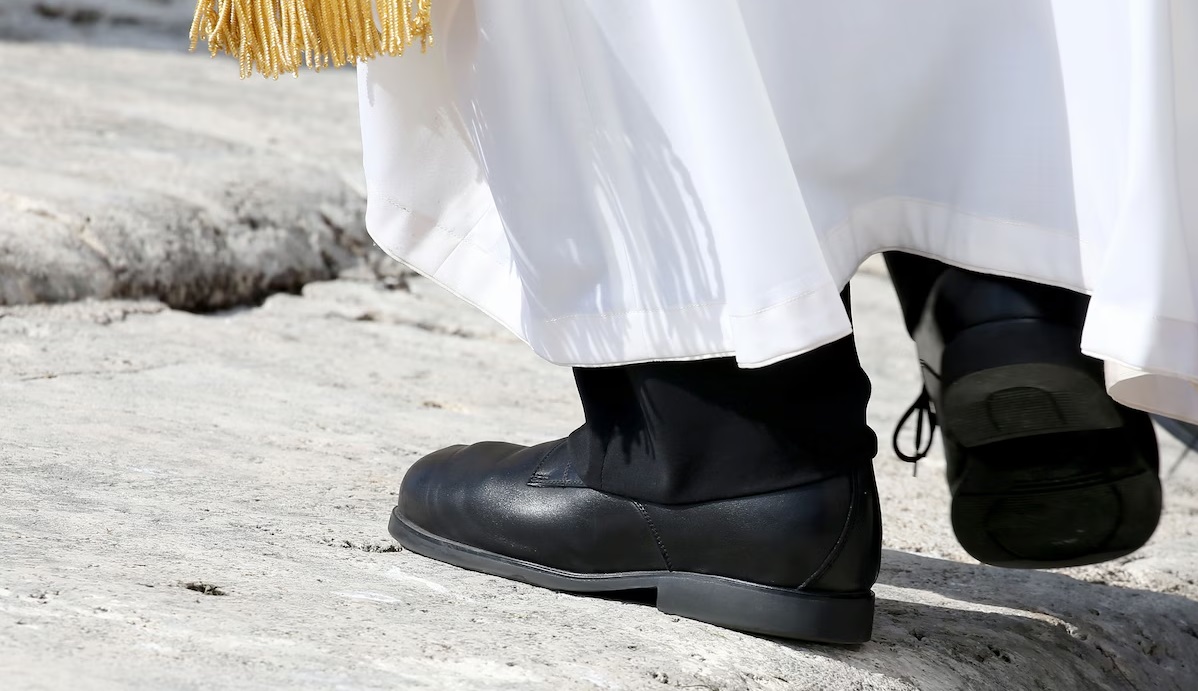
Francis also sought everyday, civilian-type accessories such as a Swatch watch or a Casio MQ-24, the latter of which retails in the United States for all of $22.95. And a few years into his tenure, Francis made headlines with his impromptu visit to a Roman pharmacy in search of some new orthopedic shoes. Many marveled at the fact that the pope hadn’t simply delegated the errand, but the shoe choice was notable: Francis was eschewing the sacred red outdoor footwear of the pope in favor of what any other octogenarian with sciatica might find more comfortable.
His appearance frequently reminded observers that he, too, was a person, with eyes that needed glasses and feet that got sore — arguably following the legend of his namesake, Saint Francis of Assisi. The 13th-century friar, so the story goes, rejected the luxurious clothes afforded to him by his wealthy upbringing and instead on several occasions stripped naked in public, to give his clothes to the poor and as a gesture of humility before God. (Francis’s humble style was one reason an artificial-intelligence-generated image of him wearing an enormous, expensive-looking white puffer coat became such a sensation online.)
And less than two weeks ago, after spending 38 days in the hospital with double pneumonia, Francis made an unannounced appearance at St. Peter’s Basilica wearing perhaps the rarest papal outfit of all: street clothes. As he greeted onlookers from his wheelchair, the pope wore black pants and a long-sleeved white T-shirt under a blanket. Other popes who have made public appearances while sick or dying — including Benedict, even after he resigned due to “lack of strength of mind and body” — still did so wearing the traditional papal cassock.
“He came to the basilica, like any other pilgrim, to pray,” Urbano says. The plainclothes-pope style caused some controversy, certainly; some understood Francis to be compromising or even abdicating the authority of the office. “But when I saw those images, I saw my elderly father and grandfather, in the fragility and weakness of their final days,” Urbano adds. “It was probably not intentional, but the choice he made not to put on his official garments that day also reflected his theology and his identification with the suffering and vulnerable.”