
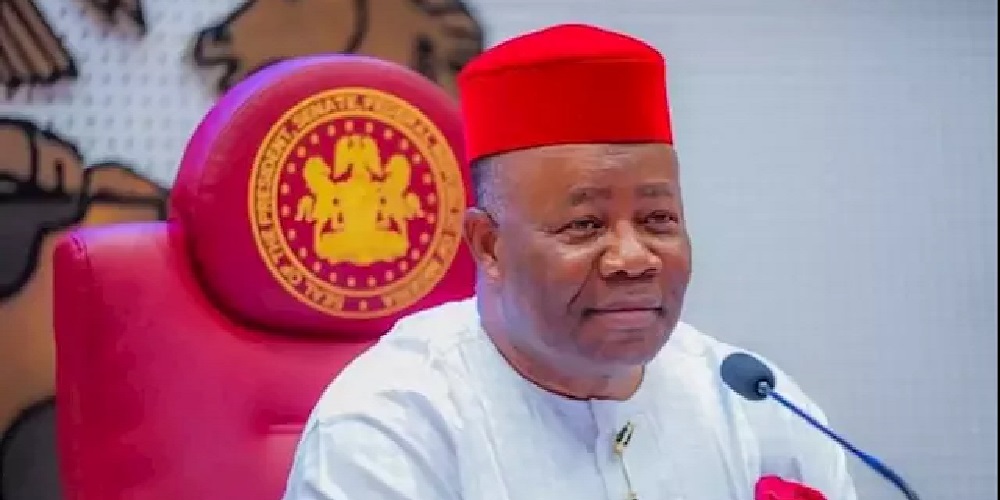





Senate President Godswill Akpabio says Nigeria’s electoral process has significantly improved since the Peoples Democratic Party (PDP) left power in 2015.
Speaking during Wednesday’s plenary session, while the Senate debated a bill seeking to repeal the Electoral Act 2022 and introduce a new Electoral Bill 2025, Akpabio reflected on Nigeria’s democratic evolution and the lessons learned from previous polls.
Akpabio, who governed Akwa Ibom State between 2007 and 2015 under the PDP and later represented the state in the Senate on the same platform, noted that elections held during the PDP era were often marred by irregularities and manipulation.
“You will agree with me that since the PDP left, elections have improved tremendously in this country,” Akpabio said. “I recall that in 2007, when I was elected governor, the then President, the late Umaru Musa Yar’Adua, publicly admitted that the election that brought him to power was flawed and riddled with inconsistencies.”
He added that subsequent administrations have made deliberate efforts to “block the holes” that once enabled electoral malpractice, pointing to technological innovations and reforms as key contributors to progress.
Addressing the lingering debate over the interpretation of “two-thirds of the states and the FCT” in the 2023 presidential election, Akpabio described it as needless, noting that the Supreme Court had already provided clarity.
“Some argued that winning the FCT alone was enough to become president,” he said. “That debate wasted valuable time until the Supreme Court clarified the issue.”
The Senate President emphasized that the proposed Electoral Bill 2025 aims to further strengthen the nation’s democracy, ensure greater transparency, and close loopholes that could undermine future elections.
“We must find a way to block these gaps to build a stronger and more credible electoral system,” he concluded.










)