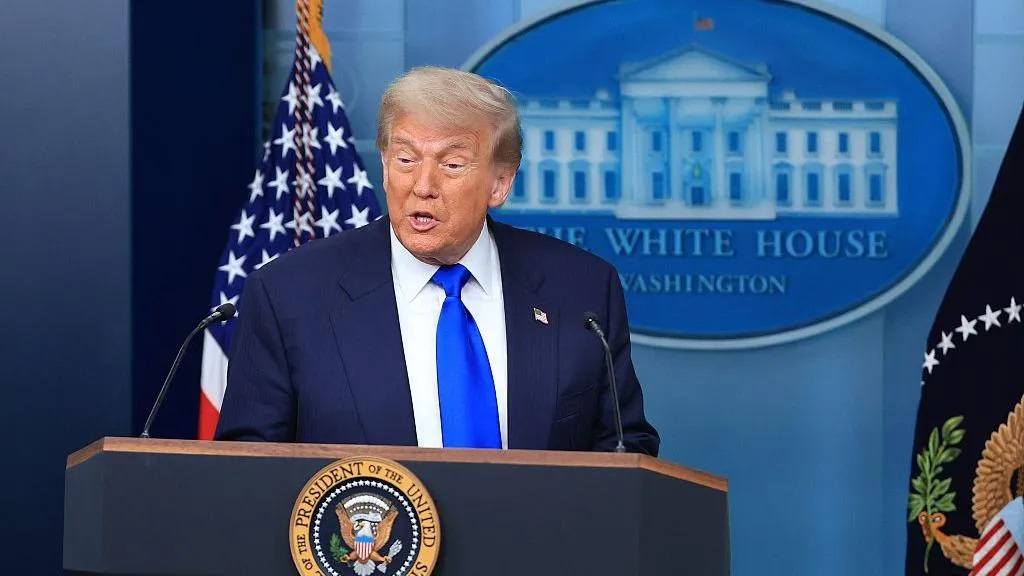





United States President Donald Trump has redesignated Nigeria as a “Country of Particular Concern,” alleging that Christians in the country are facing systematic persecution and mass killings by radical Islamist groups.
In a statement posted Friday on his Truth Social platform, Trump claimed that “thousands of Christians have been killed” and urged the United States Congress to launch an immediate investigation into what he described as “an existential threat” to Christianity in Nigeria.
“Christianity is facing an existential threat in Nigeria. Thousands of Christians are being killed. Radical Islamists are responsible for this mass slaughter. I am hereby making Nigeria a ‘COUNTRY OF PARTICULAR CONCERN’ — but that is the least of it,” Trump said.
He continued: “When Christians, or any such group, are slaughtered like is happening in Nigeria (3,100 versus 4,476 worldwide), something must be done! I am asking Congressman Riley Moore, together with Chairman Tom Cole and the House Appropriations Committee, to immediately look into this matter and report back to me.
“The United States cannot stand by while such atrocities are happening in Nigeria and numerous other countries. We stand ready, willing, and able to save our great Christian population around the world!”
Trump’s declaration has intensified an ongoing debate in Washington, where some lawmakers and public figures have accused the Nigerian government of turning a blind eye to religious violence.
US Senator Ted Cruz and Congressman Riley Moore are among those pushing for stronger punitive measures against Nigerian officials allegedly complicit in what they describe as “faith-based persecution.”
Cruz, in a recent statement, claimed that Nigerian government officials were “ignoring and even facilitating the mass murder of Christians by Islamist jihadists.” He said it was “long past time to impose real costs on the Nigerian officials who facilitate these activities,” adding that he had introduced the Nigeria Religious Freedom Accountability Act in the US Senate to sanction such individuals.
Cruz further claimed that Christians in parts of Nigeria were “being forced to submit to sharia law and blasphemy laws,” which, he argued, amounted to systemic oppression.
Congressman Riley Moore, who represents West Virginia’s 2nd District, has also written to US Secretary of State Marco Rubio, urging him to formally designate Nigeria as a “Country of Particular Concern.” He called for the suspension of arms sales and military support to Nigeria until, in his words, the government “demonstrates commitment to ending a reign of persecution and slaughter against Christians.”
The international outcry over religious freedom in Nigeria has also drawn attention from American media figures. HBO host and comedian Bill Maher recently joined the fray, describing the situation as a “genocide attempt” against Christians.
“I’m not a Christian, but they are systematically killing the Christians in Nigeria. They’ve killed over a hundred thousand since 2009. They’ve burnt 18,000 churches. These are the Islamists, Boko Haram. This is so much more of a genocide attempt than what is going on in Gaza,” Maher said.
He added: “They are literally attempting to wipe out the Christian population of an entire country.”
But the Federal Government of Nigeria has strongly rejected the claims of genocide. The Christian Association of Nigeria (CAN) also dismissed the reports as “false narratives peddled by foreign agents,” while the Presidency insisted that there was no religious war in the country.
The Feseral Government officials maintain that the violence in parts of Nigeria is driven by criminality, terrorism, and communal conflicts—not religious persecution.
Trump’s designation, though largely symbolic, could carry significant diplomatic implications. A “Country of Particular Concern” label often precedes potential sanctions, restrictions on military aid, or the suspension of bilateral programmes, depending on the US government’s subsequent actions.
Analysts say the move also marks a political flashpoint in US foreign policy toward Nigeria, especially as Washington continues to balance its security cooperation with concerns about human rights and religious freedom.
As reactions pour in from both sides of the Atlantic, observers say the coming weeks will reveal whether Trump’s call will gain traction within the US Congress—and how Nigeria’s government will respond to renewed scrutiny of its handling of religious tensions.