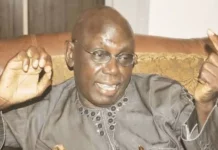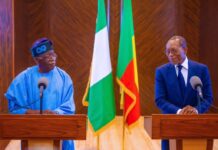





I first met the late Chief Abiola Ajimobi when the Best of Nollywood (BON) Awards was hosted in Oyo State. My respected elder, Senator Musiliu Obanikoro, introduced me to him. He embraced the idea with remarkable enthusiasm, so much so that years later he supported our engagement with the Kano State Governor to host the same awards. That early encounter left a lasting impression. He was warm, courteous, and unexpectedly humble. Power did not sit loudly on him.
At the time, I could not have imagined that years later I would embark on what has become both a personal and professional journey to understand the man beyond politics—a journey I now describe as researching a true Koseleri, with the aim of producing his biopic.
In Yoruba thought, Koseleri speaks to the unprecedented. It refers to an achievement that has never been accomplished before—breaking limits, redefining possibility, and altering the course of history. Within that context, the late Chief Abiola Ajimobi fits the description perfectly, having become the first governor in Oyo State to break the second-term jinx.
Koseleri is not about noise or self-celebration. It is about impact, custodianship, and how a leader carries authority, responsibility, and consequence with discipline and conscience. Ajimobi embodied these values quietly but firmly.
When he passed away in 2020 during the COVID-19 pandemic, the silence that followed felt heavy. Yet, over time, something revealing occurred. People continued to mark his birthday. They gathered with his family not out of political obligation, but from genuine respect. Loyalty of that nature does not survive on propaganda; it endures because of impact.
During his lifetime, Ajimobi was one of the most misunderstood governors of his era. Much of the controversy surrounding his administration stemmed from his insistence on order, particularly during the crises involving traditional rulers in Oyo State. Obas occupy a deeply symbolic and culturally sensitive position, and any attempt to regulate that space is often misinterpreted as hostility toward tradition.
He was accused of many things. Narratives were distorted and motives questioned. However, as I began work on his biopic—speaking with those who worked closely with him and examining records of his administration—I discovered that many of these narratives were unfair, and in some cases, entirely untrue.
As governor from 2011 to 2019, Chief Abiola Ajimobi brought structure to governance in Oyo State. His administration prioritised urban renewal, infrastructure, and security. The Mokola Flyover—the first flyover constructed by a civilian administration in the state—became a lasting symbol of his commitment to long-term planning. Roads across Ibadan and other major towns were reconstructed, flood-prone areas were addressed, and environmental sanitation was enforced. These measures were sometimes unpopular, but they were effective.
Security improved under his watch through coordinated community policing initiatives, making Oyo State one of the more stable states during a period of widespread national insecurity. He invested in education, rehabilitated public schools, and supported technical and vocational training, driven by the belief that governance must translate into real opportunities for young people.
His economic policies opened Oyo State to investors, encouraged private-sector participation, and promoted job creation. Many of these initiatives laid foundations that outlived his administration.
However, the clearest expression of Koseleri in Ajimobi’s political life came in 2015, when he became the first governor in the history of Oyo State to win a second consecutive term. No governor before him had achieved this. It was unprecedented. It rewrote the state’s political record and confirmed that, beyond criticism and controversy, the people trusted his leadership enough to return him to office.
Chief Abiola Ajimobi was not a governor who chased applause. He governed with firmness, and firmness often attracts resistance. But firmness is not cruelty, and discipline is not wickedness. What my research continues to reveal is a man who believed deeply in order, institutions, and legacy—a leader who understood that development sometimes demands unpopular decisions.
This is why I describe my work as researching a true Koseleri. Ajimobi did what had not been done before. He reset expectations and proved that structured governance could endure beyond a single term.
Today, as narratives about him grow more balanced and his achievements speak louder than past controversies, history is beginning to treat him more kindly than his own time did.
Ajimobi may no longer be here, but the evidence of his governance remains—in roads, in institutions, and in political records that still stand. And as this research continues, one truth becomes increasingly clear: some leaders are fully understood only after they are gone.