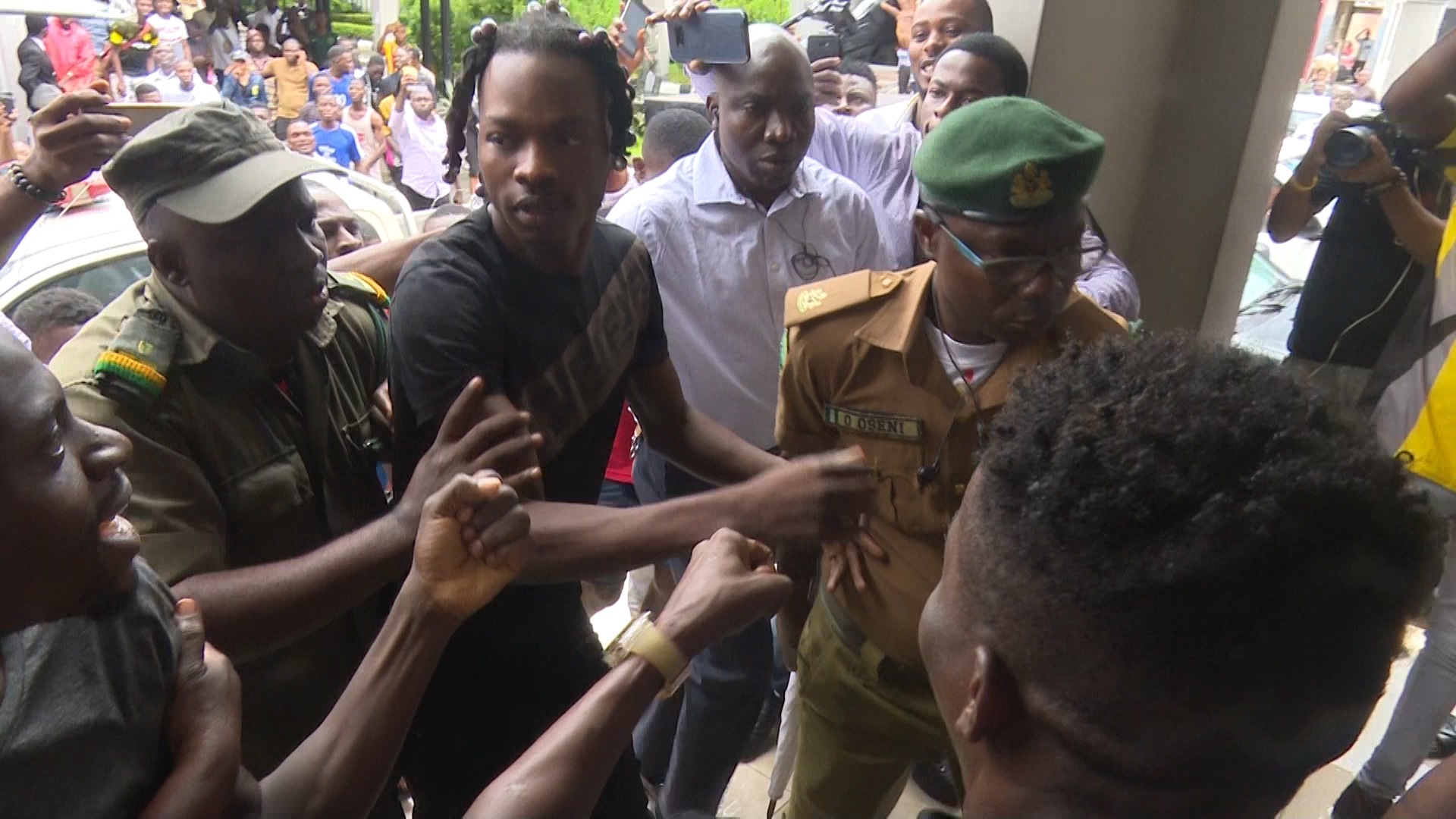





The second prosecution witness, PW2, Augustine Anosike, a forensic expert with the Economic and Financial Crimes Commission, EFCC, in the case of Afeez Adeshina Fashola, also known as Naira Marley, on Tuesday, told Justice Nicholas Oweibo of the Federal High Court in Ikoyi, Lagos how several credit card numbers were extracted while analyzing the contents of a total of 2,410 messages found in the popular singer’s mobile phone.
Naira Marley was arraigned by the EFCC on May 20, 2019 on an 11-count charge of alleged conspiracy, possession of counterfeit credit cards and fraud while he pleaded not guilty to the offence.
At the resumed hearing of the matter on Tuesday, Anosike, who continued his examination in chief, told the court that Exhibit F was a conclusion of his analysis of the defendant’s iPhone X version 10.6, model A 1901, with number 07427343432 and an email, naimarley@icloud.com.
He also gave the IMEL number of the iPhone as: 35304509527532 as well as the SIM ICCID number as 8923420035948359826.
Led in evidence by the prosecuting EFCC lawyer , Rotimi Oyedepo, Anosike also told the court that “The apple iPhone is a sophisticated device capable of storing a large volume of information.”
The witness further said, “It is the SIM card that basically identifies users of applications like WhatsApp.
“ It, therefore, means that as long as a number has already been registered with a particular WhatsApp account, it matters less if such a user leaves the country.”
In his further testimony, Anosike said: “There are cases where a WhatsApp application can still be used even though the registered SIM card is not inserted in the phone.
“ The chatting app used in the analysed device was WhatsApp.”
When asked to talk about his findings while analyzing the phone, the witness told the court that a “ total of 977 Short Message Service (SMS) and 1433 chat messages were discovered.
“ We also discovered seven pending status update messages.
“On November 26, 2018, there was an outgoing message registered about 3.32 p.m., with a credit card number 5264711020433662.
“This message was sent to one Yadd.
“ On December 11, 2018, there was an incoming message to the defendant’s device which read: ” Your One Time Passcode (OTP) to verify your mobile number is 248716; wasn’t you, please call us on 63450808500.”
According to him, another message was sent at about 5.06pm by one Hiya Bayi to a recipient with the name Raze on the same say.
The content of the message, he told the court, was another credit card number 42658840359132.
“ The number of the sender is +447426343432, while that of the receiver is +447365280441.
“ The incoming message reflected at 6.18p.m. showed ” Not recognized”.
“Other messages received on the same date include:” due to try in 20 minutes,” he added.
The prosecution witness, while giving further evidence, told the court that there was an incoming message which read: “Tried and it was unsuccessful; sure you are not rinsing it out then giving it to me to try.” On December 12, 2018 at 10.16p.m.
During the proceedings, the witness also revealed several credit card numbers sent on different dates and time as well as OTP codes sent found in the defendant’s phone.
Oyedepo thereafter told the court that all the analysed texts were fully contained in a Compact Disc (CD).
He, however, told the court that the prosecution had only printed out those portions it considered material to its case.
Consequently, he asked both the court and the defence counsel, Olalekan Ojo, SAN, if the prosecution could bring a projector to play the CD in the open court or not.
Also, Ojo did not raise any objection to the request by the prosecution.
Justice Oweibo consequently granted Oyedepo’s request.
The matter was later adjourned till Wednesday for the prosecution to play the CD on a projector.