




* Insists President a beneficiary of direct primary
* Says action indicates Buhari dumps electronic voting
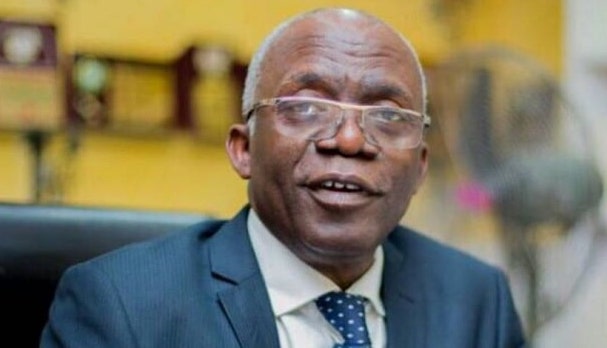
A legal luminary and human rights activist, Mr Femi Falana (SAN), has faulted President Muhammadu Buhari over his rejection of the Electoral Amendment Bill, saying that the reasons adduced by the President in declining assent are grossly misleading.
Falana stated this on Tuesday while reacting to the President’s letter to the National Assembly, stating reasons for declining assent to the much important bill.
The legal icon also stated that it is regrettable that the President has also rejected the innovative electronic voting which he endorsed when he admitted that he is a beneficiary of electronic accreditation of voters through the use of card readers.
The Senior Advocate also stated that Section 87 of the current Electoral Act provides for either direct or indirect primaries, saying that the APC used direct primary for the emergence of its presidential candidate in 2019.
According to Falana, President Buhari is a beneficiary of direct primary.
Falana, who is also the Interim Chair, Alliance on Surviving Covid-19 and Beyond (ASCAB), stated that by rejecting bill on the grounds that it provided for direct primary, the President has decided to throw away the baby and the bath water.
He said, “Thus, the President rejected electronic voting which he had endorsed when he admitted that he is a beneficiary of electronic accreditation of voters by the use of card readers.
“With respect, direct primary is in consonance with section 223 of the 1999 Constitution (as amended) which has imposed a duty on political parties to elect their officers through democratic elections.
“There is no provision in the Constitution for imposition of candidates by money bags through indirect primaries.”
Falana also dwelled on the submission of the Independent National Electoral Commission (INEC) bill to the National Assembly, seeking for N305billion to conduct the 2023 general elections.
He then wondered: “ So, who conjured the figure of N500billion for the primaries to give the impression that it is an expensive venture?
“In any case, since electronic voting had been adopted by the National Assembly, it was going to be used for both primary and general elections. So, the cost would have been significantly reduced.”
On the issue of insecurity, which was cited by the President as one of the reasons for declining assent, Falana said, “The fear of insecurity is a red herring in that political parties have continued to hold huge rallies even in defiance of Covid 19 restrictions imposed by the Federal Government.”
He then said, “Having rejected to assent to the Electoral Amendment Bill in 2018 and 2021, President Buhari has confirmed beyond any shadow of doubt that his administration will not allow INEC to conduct credible elections in 2023 and thereafter.
“That is going to be the tragic legacy of the President and the ruling party that were campaigning for electoral reforms before the 2015 general elections.”
Asking the National Assembly to invoke the constitutional provision and pass the bill, Falana said, “The challenge before the National Assembly is to invoke the provision of section 58 (5) of the 1999 Constitution to pass the Bill into law by the resolution of two-thirds majority of the members.”
The Senior Advocate also canvassed for a win-win situation, saying that if the National Assembly is unable to muster the two-thirds majority, the lawmakers should ensure that the direct and indirect primaries are left intact as enshrined in section 87 of the Act.
He said, “However, if the National Assembly cannot muster the required two-thirds majority, section 87 of the Act which allows direct or indirect primaries should be left intact so that the other provisions of the Electoral Amendment Bill 2021 can be passed again by the legislators and assented to by the President.”