






…Voids lower court order on electronic transmission of results
The Court of Appeal in Lagos has held that the Independent National Electoral Commission (INEC) has the legal power to determine the mode of transmitting of results and set aside the judgement of a Federal High Court which ordered the Independent National Electoral Commission (INEC) to directly and electronically upload the election results of the Governorship and State of Assembly elections from the polling units to the INEC Results Viewing Portal (IReV).
In its unanimous judgment delivered on Wednesday, July 19 by the Justice of the Court of Appeal (JSC), Justice Abubakar Umar and concurred with by Justices Olukayode Bada and Onyekachi Otisi, the appellate court held that INEC has wide discretionary power to chose its method of transmitting results arising from elections.
Justice Peter Lifu of the Federal High Court in Lagos had in his judgment on March 8, granted the mandamus order to the Labour Party (LP), its governorship candidate, Gbadebo Rhodes-Vivour; and 41 others, compelling INEC to obey the Electoral Act and its guidelines for the conduct of the elections.
In the judgement, Justice Lifu directed INEC to comply and enforce the provisions of Clauses 37 & 38 of the Regulations and Guidelines for the Conduct of the Governorship and State Houses of Assembly Elections in Lagos State which mandates presiding officers of all polling units to paste the publication of result posters at the polling units conspicuously after completing the EC8A result sheet.
The judge also mandated the presiding officers to electronically transmit/transfer the results of the polling units directly to the collation centre and a scanned copy of the EC8A to INEC’s IReV immediately after the completion of all the polling unit’s voting and result procedure.
Justice Lifu also directed INEC to observe, comply and enforce the provisions of Section 27(1) of the Electoral Act 2022 in the distribution of electoral materials during the elections by engaging the services of non-partisan, independent and reliable logistics companies.
Dissatisfied with the verdict, the All Progressives Congress (APC) and Social Democratic Party (SDP) sought leave of the court to appeal the judgement and eventually filed their notices of appeal as interested parties.
In the documents before the court, the APC said despite not being joined in the suit, it had deemed it fit to appeal the judgement on the grounds that it was aggrieved by the decision which it said would affect its interest as a sponsor in the same elections as the SDP.
The APC noted that the Labour Party had earlier filed a suit against INEC at the Federal High Court in Abuja where it raised the same issues and sought similar reliefs which it re-litigated and re-sought at the Lagos division of the court.
The APC also noted that by the judgement of the Federal High Court in Abuja on January 23, 2023, INEC was at liberty to prescribe the manner in which election results could or ought to be transmitted by virtue of sections 50(2) and 60(5) of the Electoral Act, 2022
According to the APC, “the said decision of the Federal High Court in Suit No.: FHC/ABJ/CS/1454/2022 between Labour Party v. INEC is valid and subsisting having not been appealed against by any person.”
The APC noted that the decision of Justice Lifu in Lagos “has given rise to confusion and uncertainties as to whether INEC has the power to determine the procedure for the conduct of election in the upcoming gubernatorial and State Houses of Assembly elections slated to hold on March 18, 2023 in Lagos State, in light of the two conflicting decisions of the same Federal High Court”.
The party also argued that the court was wrong to have refused an application for a joinder filed by the SDP, adding that the matter before the Lagos court had far-reaching consequences that affected all registered political parties involved in the 2023 general election.
But the three-man panel of the Court of Appeal in its judgement, raised a single issue for determination, saying that it was whether Justice Lifu was right to have granted the order of mandamus against all 43 respondents in the suit.
The appellate court also noted that the Labour Party, its governorship candidate and all the other respondents did not file any brief to join issues with the APC despite being served with the briefs.
The appellate court also held that contrary to the position of the lawyers for the Labour Party and its governorship candidate, there was proof that the notice of appeal was served on all the respondents by the court bailiff.
Resolving the sole issue for determination, the appellate court agreed with the APC that Section 50(2) and Section 60(5) of the Electoral Act 2022 give INEC “very wide discretionary powers” to determine how it carries out its assignment including the manner it transmits or transfers election results from the polling units to the collation centre.
The appellate court also held that although Justice Lifu premised his decision on Clauses 37 and 38 of INEC’s Regulation and Guidelines, the Electoral Act gives the commission flexibility to “amend or vary” its regulations.
Justice Umar then said, “It is my considered view that the power to make a regulation or guideline necessarily entails the power to amend or vary it,” especially if it deems it necessary or exigencies warrant such.
“With due respect to the learned judge, an order of mandamus cannot be granted to fetter a discretion”.
The JCA also held that not even the allegation that INEC breached its regulations during the conduct of the presidential poll can justify the order of mandamus issued by the lower court “because that is an issue for the election tribunal”.
The appellate court also averted its mind to the decision of Justice Emeka Nwite of the Federal High Court, Abuja and agreed with the APC that the suit in Lagos is an abuse of the court process.
In the suit, Justice Nwite, while delivering judgement, held that INEC is at liberty to specify or pick the method of transmitting election results.
Having previously filed a suit and obtained judgment at the Federal High Court in Abuja , the appellate court held that the party ought not to have filed a similar suit bordering on the same issues in Lagos. It subsequently found merit in the appeal and resolved the issues in favour of the APC.
JCA Umar then concluded that , “I hereby make an order setting aside the judgment of P.O. Lifu delivered on the 8th March 2023 in Suit No: FHC/L/CS/370/2023. In its place, I make an order dismissing the suit, i.e. Suit No: FHC/L/CS/370/2023 in its entirety for being an abuse of the court process. Parties shall bear their respective costs”













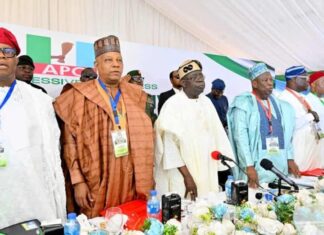
 has the legal power to determine the mode)