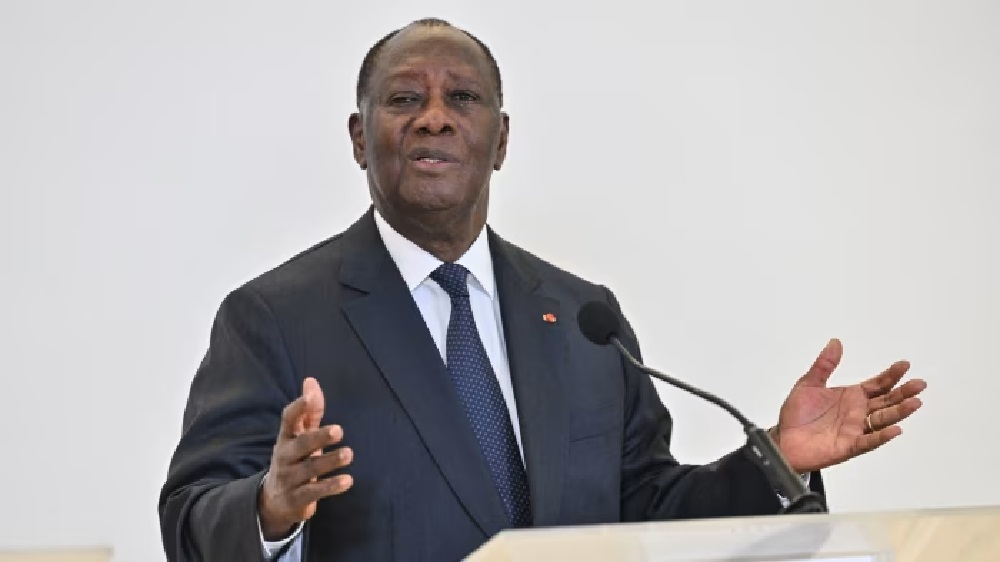





Ivory Coast’s President, Alassane Ouattara, has clinched a resounding fourth-term victory, winning a commanding 89.77 percent of the votes in a presidential election that excluded his two most formidable challengers, according to results released by the country’s electoral commission on Monday.
Nearly nine million Ivorians were eligible to cast their ballots in Saturday’s poll across the world’s largest cocoa-producing nation—one that has so far managed to steer clear of the coups and jihadist insurgencies destabilising many parts of West Africa. However, the election season was marred by heightened political tension and bouts of deadly violence.
Even before the official announcement, Ouattara’s triumph was widely anticipated. Preliminary results from Sunday had already shown him cruising to victory with over 90 percent of the votes. Voter participation was near total in his northern strongholds, reflecting the enduring loyalty of his base.
Interestingly, the veteran politician also took the lead in several areas traditionally known for opposition support, including parts of the southern regions and segments of Abidjan, the nation’s bustling commercial capital, where polling centres were largely deserted on election day.
According to the chairman of the Independent Electoral Commission, Ibrahime Kuibiert Coulibaly, entrepreneur Jean-Louis Billon finished a distant second with 3.09 percent of the total votes cast. He disclosed that voter turnout stood at 50.10 percent—roughly the same level recorded in 2020, when Ouattara secured 94 percent of the vote amid a boycott by leading opposition figures.
In this year’s contest, both of Ouattara’s chief rivals—former president Laurent Gbagbo and former Credit Suisse Chief Executive Officer Tidjane Thiam—were ruled ineligible to contest. Gbagbo was disqualified due to a criminal conviction, while Thiam was barred for holding French citizenship.
“Their absence, their calls not to participate in the election, and the climate of tension that deteriorated in recent days foretold a significant demobilisation of the electorate,” observed William Assanvo, a senior researcher at the Institute for Security Studies (ISS).
In Gagnoa, Gbagbo’s traditional bastion in the south, Ouattara recorded a staggering 92 percent of the vote, although voter turnout there barely reached 20 percent.
The opposition coalition has since rejected the results, declaring that it “denies any legitimacy” to Ouattara’s victory and is calling for a fresh election.
Political analyst, Geoffroy Kouao, said the turnout figures reveal a deeper story. “First, Mr Ouattara’s supporters turned out in force, as shown by the Soviet-esque results in certain regions,” he noted. “And second, supporters of the (Gbagbo and Thiam’s parties) did not go to the polls.”
Billon, who placed second, also lamented the “very low turnout in some regions,” while extending his congratulations to Ouattara.
Despite their participation, none of the other contenders, including former First Lady Simone Ehivet Gbagbo, had any realistic pathway to a run-off. Their campaigns were hampered by limited political structures and meagre financial backing.
The tense build-up to the polls had been punctuated by violent clashes after opposition calls for street protests. At least eight people were reported killed earlier in the month, while nearly two dozen others sustained injuries in election-day disturbances affecting roughly 200 polling stations nationwide.
Authorities had responded by imposing nighttime curfews in sensitive areas and deploying more than 44,000 security personnel to maintain order.
Ivory Coast’s presidential elections have long been flashpoints for political unrest. Ouattara’s initial rise to power came after the disputed 2010–2011 polls, which spiralled into civil conflict, leaving over 3,000 people dead.
By Monday, life in Abidjan had largely returned to normal. The once-deserted capital gradually regained its usual bustle as residents resumed daily activities.
“The Ivorians said NO to prophets of doom,” declared the pro-government daily Le Patriote, hailing what it described as “a calm election.”
Conversely, the opposition newspaper Notre Voie offered a starkly different interpretation, describing the outcome as “an election reflecting a divided country.”