
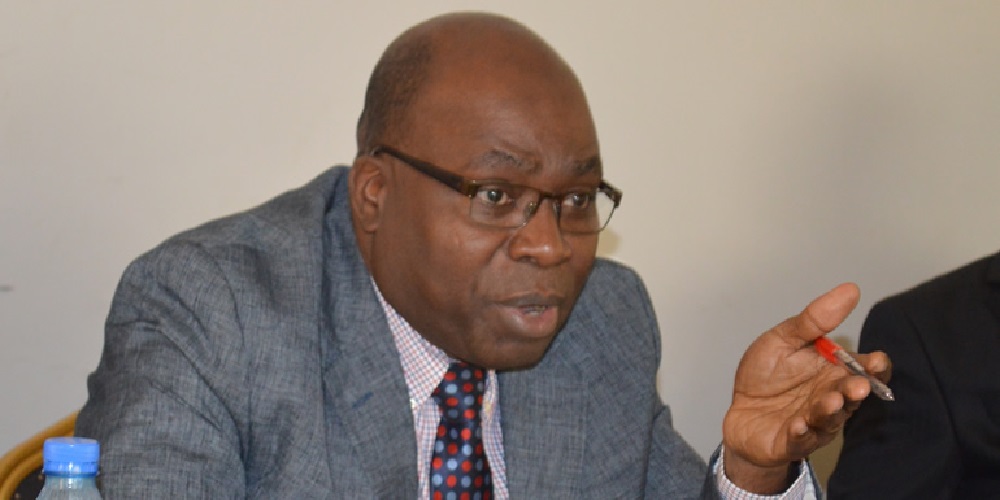





The outgoing Chairman of the Independent Corrupt Practices and Other Related Offences Commission (ICPC), Bolaji Owasanoye, SAN, has blamed top civil servants and politicians for the high level of corruption in Nigeria.
He, however, faulted the hasty generalisation that casts aspersion on all Nigerians as being corrupt.
Mr Owasanoye, a law professor, spoke at the Behavioural Change and Conference Exhibition, 2023, on Wednesday in Abuja.
The conference themed, “Fostering a corruption free Nigeria,” was organised by the Akin Fadeyi Foundation (AFF), a not-for-profit, communication-for-change organisation that employs media resources and technology in combating corruption and promoting social change in Nigeria.
Mr Owasanoye, who was a guest speaker at the event, narrated how the lack of administrative experience led the heads of some government agencies, particularly academics, into culpability in acts of corruption. He said they become ICPC suspects within one year in office as a result of infractions.
“And you could see that many of them, walking blind, lacked administrative experience, either because they are misled or because they have not read circulars and guidelines that say you can do this…(but) you can’t do that,” he stated.
He added, “Imagine somebody who hitherto had a global reputation, who won consultancies, earned $20,000 a month; why does he want to come and steal money from an MDA?
“Except somebody has set a banana peel for him to enable them to do what they want to do and they need to put him in that trap. And then, if he refuses, they will orchestrate a petition to ICPC, to EFCC…and embarrass him.”
For him, most of the people who indulge in such acts are usually faceless civil servants who lead the heads of government MDAs into misdemeanours in the first place.
On his avowal that not all Nigerians are corrupt, the outgoing ICPC chair stated that he has had cause to scrutinise this pervasive mindset and found out that it is quite misleading.
“From my experience in leading the anti-corruption fight at PACAC (Presidential Advisory Committee Against Corruption) and the ICPC, I can tell you categorically that not all Nigerians are corrupt,” he said.
Mr Owasanoye shared the experience of the head of a federal agency who wanted to embark on an international trip but was mischievously misled by the organisation’s director of finance that the estacode for such trip was $900 a day, instead of the approved $600 per day.
He said it was a sense of caution and circumspection on the part of the agency’s head that made him verify and find out the correct amount, adding “otherwise he would have walked into a booby-trap set for him, leading to official abuse and corruption.”
Also, speaking at the Conference, the Country Director of MacArthur Foundation, Kole Shettima, observed the significance of behavioural change in tackling the menace of corruption in Nigeria.
He traced the history of how this approach was adopted by the Foundation, following a training in Harvard University, after which it was brought down to the local level, leading to its adoption in the work of a number of MacArthur grantees, which became a cohort around the approach.
He emphasised the necessity of behavioural insights and change in fighting corruption in the country.
On his part, the founder of the Akin Fadeyi Foundation, Akin Fadeyi said that, “This event is not just to showcase our work, it is strategic to re-evaluating our scorecard and redesigning more robust templates aimed at scaling up our milestones for measurable impact.”
He said the Foundation was excited the event “was successful and well-attended by experts and the international development community. Hence, it is imperative to convey our gratitude to the Nigerian Media across-board especially, as they have been the sustained strategic partners through which our efforts are conveyed to the larger populace.”
Mr Fadeyi, who noted that the behavioural cohort consists of 18 civil society organisations, which have been working as partners as grantees of the MacArthur Foundation, while leveraging each other’s expertise in addressing the cause of behavioural change as a remedy to corruption and other social vices undermining societal development.
According to him, the exhibition that was a core part of the event, was “a convergence of ideas and a unifying front for partners like the StepUp Nigeria, ACAN, NISER, Lux Terra Foundation, Accountability Lab etc.”
He added, “We have been re-energised in our irrevocable commitment to keep employing behavioural change and tech-driven approaches in breaking down barriers against our nation’s preponderant decadence.”
Mr Oliver Stolpe, country director of the United Nations Office on Drugs and Crime (UNODC), who was represented by Lilian Ekeanyanwu, Head of the organisation’s Technical Unit on Governance and Anticorruption Reforms (TUGAR), stated that, “The fight against corruption is not complete without addressing issues of transparency, integrity, and accountability.
At the core of these values is behavioural change or the attitudes of citizens and their political leaderships. As we already know, combatting and preventing corruption requires a holistic framework and multi-sectoral approach.”
Speaking earlier, the General Overseer, Palace of Priests Assembly (PPA), Abuja, Otive Igbuzor, said the problem of corruption is a global one.
He noted that over the years, several scholars, development workers, activists, politicians, international organisations, public affairs commentators and the general public have given attention to the problem of corruption and its attendant effects on society.
He added that the problem is not new to humankind, even though it has reached unprecedented proportions in recent years.
“There has been a lot of focus on how to mitigate the impact of corruption. Strategies, programmes and agencies have been put in place to address the problem of corruption. But the challenge remains.
Despite the plethora of legislations and agencies fighting corruption in the country, corruption has remained widespread and pervasive because of failure to utilise universally accepted and tested strategies; disconnect between posturing of leaders and their conduct; lack of concrete sustainable anti-corruption programming and failure to locate the anti-corruption struggle within a broader struggle to transform society,” Mr Igbuzor said.
The one-day conference consisted of a series of panels in which each of the 18 organisations in the cohort spoke about the work it had been doing, while leveraging the behavioural change approach, alongside its impacts so far.
The organisations then jointly set an agenda for deepening their public engagement within the frame of behavioural insights, going forward.



















, Bolaji Owasanoye, SAN, has blamed)