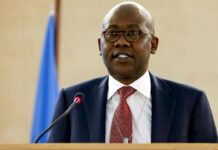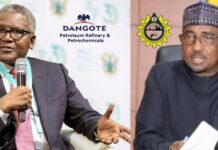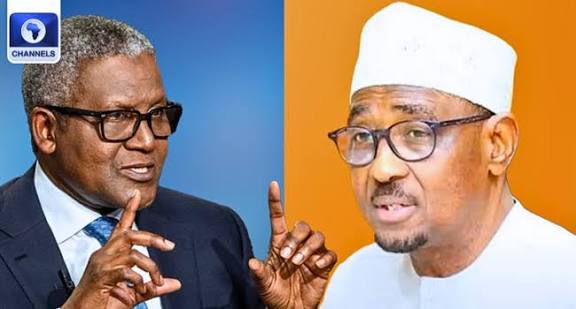





The Chief Executive Officer of the Nigerian Midstream and Downstream Petroleum Regulatory Authority (NMDPRA), Engr. Farouk Ahmed, has faulted the allegations by the President of Dangote Group, Alhaji Aliko Dangote, that he funded his children’s education in Switzerland with illicit funds.
He also described the claims as misleading, ill-timed, and driven by vested commercial interests threatened by regulatory reforms.
Speaking in a statement dated December 16, 2025, Ahmed said the allegations—particularly claims that he spent about $5 million on Swiss secondary education—were not only exaggerated but deliberately stripped of context.
Farouk added that he welcomed scrutiny of his finances and formally invited Nigeria’s anti-corruption and oversight agencies to investigate his assets and income spanning over three decades in public service.
He said, “I welcome scrutiny, but the timing and nature of these claims demand context that only three decades of public service can provide.”
Farouk traced his professional journey to 1991, when he joined Nigeria’s petroleum administration through the civil service examination, rising from a junior engineer in the Department of Petroleum Resources (DPR) to Chief Executive of the NMDPRA.
He emphasized that his career progression was rooted in technical competence rather than political patronage, with early years spent in crude oil marketing, gas supply monitoring, and downstream operations—areas where, according to him, decisions are governed by engineering standards and market realities rather than politics.
Farouk further disclosed that by 2012, he became the General Manager of the Crude Oil Marketing Division, overseeing Nigeria’s most critical revenue stream during a period of volatile global oil prices, saying that by 2015, he became the Deputy Director in charge of downstream regulation at a period of fuel scarcity challenges and pricing controversies that taught him “principled positions often create powerful opponents.”
He explained that his appointment as NMDPRA CEO in 2021 came with a clear mandate: to implement the Petroleum Industry Act (PIA) reforms transparently and without favoritism—an assignment he knew would unsettle entrenched interests.
Clarifying the allegations of education funding of his children, Farouk dismissed the $5 million figure as misleading, saying d that three of his four children received merit-based scholarships covering between 40 and 65 percent of tuition costs, adding that such records are verifiable.
He further revealed that his late father, a Northern Nigerian businessman, established education trust funds for his grandchildren before his death in 2018, in line with cultural traditions of extended family investment in education.
He said, “When scholarships, family contributions, and my own savings accumulated over three decades are properly accounted for. My financial obligation was entirely consistent with someone of my professional standing.”
Farouk noted that his annual compensation as NMDPRA CEO—about N48 million including allowances—is publicly disclosed in audited reports and that he has submitted asset declarations to the Code of Conduct Bureau every year since entering public service.
He also said that he has authorized all educational institutions attended by his children to release financial records to Nigerian investigators, saying that foreign schools do not accept fees derived from illegitimate sources—an assertion he framed as common knowledge behind why Nigerians refer to foreign countries as “saner climes.”
The NMDPRA boss linked the resurfacing of the allegations to recent regulatory actions taken by the Authority, including stricter licensing requirements, enforcement of quality standards that exposed substandard petroleum products, and the introduction of transparent pricing mechanisms.
“These allegations resurface precisely when NMDPRA has enforced standards that eliminate opacity benefiting certain market players,” Farouk said, adding that the timing was “not coincidental.”
He rejected claims that recent import licensing approvals amounted to economic sabotage, arguing that Section 7 of the Petroleum Industry Act mandates the Authority to ensure supply security and prevent scarcity.
He said, “A single-source supply model creates dangerous vulnerabilities that no responsible regulator can ignore.”
Farouk added that since 2021, NMDPRA has published monthly supply reports, launched public data portals, reduced fuel queues through improved supply-chain management, and enforced quality standards without discrimination—reforms he admitted have created friction with businesses accustomed to preferential treatment.
Farouk further invited the Code of Conduct Bureau to review all his asset declarations since 1991 and urged the Economic and Financial Crimes Commission (EFCC) to examine his financial transactions while calling on the National Assembly to exercise its oversight powers over his tenure.
“I will cooperate fully and answer all questions under oath if required,” he said, insisting only that any probe must be professional and free from preconceived conclusions driven by commercial interests.
Describing the controversy as the cost of regulatory independence, Farouk said he was prepared to endure personal attacks rather than compromise statutory duties.
“If the price of regulatory independence is personal attacks and manufactured scandals, I accept that price,” he declared.
He concluded by expressing confidence that a thorough investigation would vindicate both his personal integrity and the reforms implemented under his leadership, insisting that history would favor principled regulation over expedient accommodation.