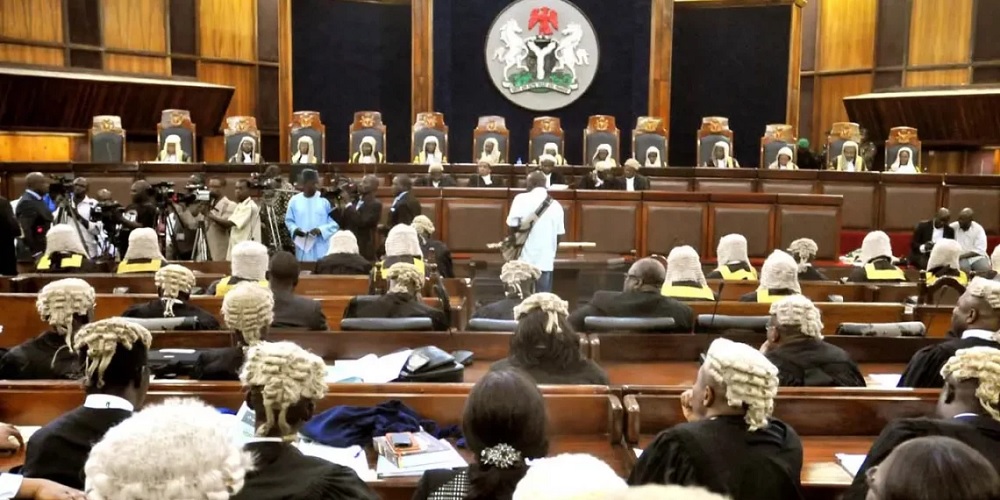





It is courteous to wish the new Justices credible and successful tenures as Supremes but that wish can only come to fruition in a court that is administered humanely and is not in deficit of public trust. On both counts, Nigeria’s Supreme Court currently has a lot of work to do.
As Nigerians prepared for the holiday season to end in 2023, the National Assembly in Abuja on 21 December hurriedly undertook and voted for the confirmation of 11 nominees for appointment to the Supreme Court.
he installation of the new Justices in this elevated judicial role was delayed as the Supreme Court worked to wind down the appellate season on petitions from the 2023 elections, some of which challenged decisions involving a number of the new nominees to the Supreme Court.
On 26 February, the Chief Justice of Nigeria (CJN), Olukayode Ariwoola, will administer oaths on the 11 new Justices of the Supreme Court. This represents the largest single complement of new intake to the bench of the court, beating the previous high watermark of eight justices who took their seats in the court in November 2020.
It will also mark the first time in its history that the court will have the full complement of 22 Justices (21 Justices and the Chief Justice) as provided for by Nigeria’s 1999 Constitution.
This situation will not last long though. If the court is not to suffer depletion in its numbers again, attention will have to be paid to the factors that got it to where it has been, to begin with.
19 months after swearing in the eight new Justices of the Supreme Court in 2020, Ibrahim Tanko Muhammad abdicated as CJN, toppled in an unprecedented mutiny against what clearly was an extreme case of judicial maladministration, if not malfeasance.
He was the second CJN to be forced out of the office for being blemished, unlike Caesar’s wife. The avoidable and premature loss of two Chief Justices in less than three years is not just careless; it is a pathology.
But this was not the only reason why the court was run down in both the numbers of its Justices and in its institutional reputation. 10 months after his swearing in as a Justice of the Supreme Court, Samuel Oseji died in September 2021. Six months earlier, Sylvester Ngwuta, one of the senior-most Justices of the Court, had died in March of the same year. 22 months after the passing of Justice Oseji, Chima Nweze, another Justice of the same court, died at the end July 2023. That brought to three the number of Justices of Nigeria’s Supreme Court who died over a period of 27 months.
It is the case that an overwhelming majority of those who rise to become Justices of the Supreme Court in Nigeria get there north of the average life expectancy for the country.
That notwithstanding, it remains the case that a situation in which the country suffers the death of a Justice of the Supreme Court at an average rate of one in every nine months is symptomatic of workplace dysfunction of the most morbid kind. The court must look at how it replaces departing Justices and even more at how it organises and manages both work and wellbeing among them.
At least two successive attempts to appoint Justices, before the latest, were aborted because of low politics unbefitting of both the process and the institution of the Supreme Court. It is to be hoped that the process of judicial elevations to the Supreme Court bench will become more transparent and less prone to base politics of the sort the court has recently endured.
Let’s begin with replacement and appointment. Over the next three years, the court is guaranteed to lose at least five of the current complement to natural attrition. Chief Justice Olukayode Ariwoola will retire in August this year. In September 2026, Justice Ibrahim Mohammed Saulawa is due to retire, to be followed in quick succession by Uwani Abba Aji two months later, Helen Ogunwumiju in March 2027 and Jonah Adah three months later.
These appointments to the Supreme Court will be the first since 2020. The only new appointment of any significance affecting the court was the replacement of Chief Justice Tanko Muhammad by the incumbent in 2022.
Indeed, no vacancy has been filled in the court since Sidi Bage resigned in March 2019 to become the Emir of Lafia. Since then, in addition to the Justices lost to death, at least seven other Justices have retired from the court. There was no excuse for the delay and dithering that followed those retirements.
At least two successive attempts to appoint Justices, before the latest, were aborted because of low politics unbefitting of both the process and the institution of the Supreme Court. It is to be hoped that the process of judicial elevations to the Supreme Court bench will become more transparent and less prone to base politics of the sort the court has recently endured. That will guarantee that replacements are both timely and fit for purpose.
Next is the health and wellbeing on the court. Anthonia Ochei reported that “although retirement and resignation are reasons for which a judicial officer may leave active service, more often than not, justices of the Supreme Court have been forced to leave office as a result of ill health that have most times resulted in death.”
For most of the past decade, Nigeria’s Supreme Court has laboured under a crippling burden of case work matched by an equally crippling loss of judicial personnel. These two trends may be related.
The Supreme Court is overwhelmingly a court of last appellate instance. It receives a few cases in its original jurisdiction as the only court empowered to decide disputes between states of the federation or between states and the federation.
Supreme Court Justices insist that they can only be saved by a constitutional amendment limiting the kinds of cases that end up in their dockets. Such an amendment may no doubt help but the Justices are not as helpless as they imply. Better court administration can help. Fuller digitisation of the court and its library could also assist with the speed of judicial conferencing, court administration and decision-making.
The doctrinal position of the court to date is essentially that it has no control over the appeals that can be filed with it. Under the constitution, all persons under a penalty of death are entitled to appeal to the Supreme Court. No one could possibly quarrel with this.
Appeals also go to the Supreme Court in relation to disputes concerning presidential and governorship elections. A majority of voters in Kano and Plateau States will agree with this, surely. These account for only a fraction of the appeals that currently burden the dockets of the Supreme Court, but for an inordinate proportion of judicial stress because they all get priority and must be decided on a short judicial calendar.
Litigants who have appeals on questions of law arising from decisions of the Court of Appeal can also proceed to the Supreme Court, irrespective of how trifling it may be. Last September, retiring senior Justice, Amina Augie, complained about how the court once sat on an appeal from a state in a case involving 12 burnt goats.
A case of 12 goats could, nevertheless, raise legal issues of extraordinary significance, although that did not appear to have been the case according to the source of complaint in the court’s conference, as the retiring Justice reported. The dockets of the court are overrun by interlocutory appeals.
Supreme Court Justices insist that they can only be saved by a constitutional amendment limiting the kinds of cases that end up in their dockets. Such an amendment may no doubt help but the Justices are not as helpless as they imply. Better court administration can help.
Fuller digitisation of the court and its library could also assist with the speed of judicial conferencing, court administration and decision-making. Properly administered judicial clerkships can relieve the Justices of some of the tedium of research and writing. And they can also interpose by doctrine or rules a summary procedure (without the need for or necessity of hearing) for appeals that are clearly without bases or justification, other than attrition or time wasting.
It is courteous to wish the new Justices credible and successful tenures as Supremes but that wish can only come to fruition in a court that is administered humanely and is not in deficit of public trust. On both counts, Nigeria’s Supreme Court currently has a lot of work to do.
Chidi Anselm Odinkalu, a lawyer, teaches at the Fletcher School of Law and Diplomacy and can be reached through chidi.odinkalu@tufts.edu.