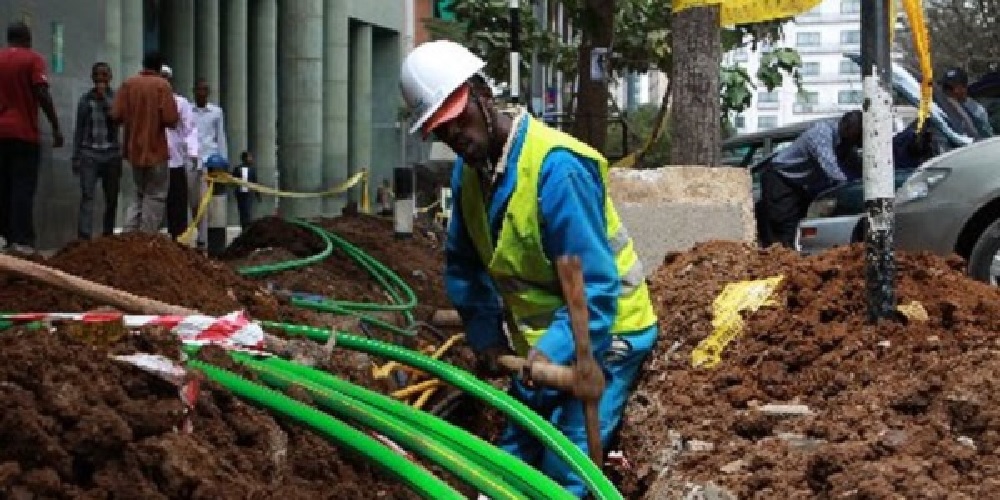





The Federal Government has announced the creation of a $2 billion fund aimed at building fibre optic connections between all 774 local government areas in Nigeria.
Although the World Bank, the African Export and Import Bank, and the United States Export and Import Bank are among the prospective funding sources, the African Development Bank has made a $200 million commitment.
According to the Federal Government, nine states will benefit from the project’s prototype stage while the states include Imo, Kogi, and Zamfara.
IThe Minister of Communications, Innovation, and Digital Economy Dr. Bosun Tijani, disclosed this on Wednesday while briefing State House correspondents after the weekly Federal Executive Council (FEC) meeting in Abuja
He said, “In the next six months, our goal is to reach at least eight of the states…and cover the entire country…we are setting up a $2 billion fund.”
According to Tijani, the country will need 120,000 km of fibre optic lines to reach full connectivity, however there are now just 35,000 km of cables in place.
The Ministry underlined in a January 2024 white paper the critical requirement of increasing Nigeria’s broadband access through the construction of middle-mile and national backbone infrastructure, with the goal of increasing internet adoption and hitting a 70 percent broadband penetration target by that time.
It pointed out that there are differences in coverage between regions and stated that improved connectivity is the strategic value of installing at least 120,000 km of fibre optic lines.
The ministry suggested what it called the National Broadband Alliance for Nigeria, a collaboration intended for promoting broadband expansion, solving inadequate internet usage, and placing Nigeria for a digital revolution in order to tackle its issues associated with market sustainability while improving digital accessibility.
It stated that by enhancing access to financial services, healthcare, education, e-commerce, and e-governance, this programme will promote social and economic growth.
Speaking about the implementation mechanisms, Tijani said, “The first thing we’re doing, which Mr. President is pushing, is leveraging existing infrastructure that we have within NIGCOMSAT, which is the satellite company. As most of you are aware, Nigeria is the only nation in West Africa possessing a satellite.
“We’re also leveraging the fiber network of Galaxy Backbone to deploy connectivity to all the 774 local government Secretariat. Those who are following that project, which was announced about three weeks ago, would also see that we’ve actually started the connectivity.
“So a number of local government secretariats in Kogi State are now connected, a number in Zamfara are being connected this week, a number in Imo State are being connected this week. In the next six months, our goal is to reach at least eight of the states within the country to demonstrate the pilot and the goal is to then take it from there and cover the entire country.”
Tijani said if these local government secretariats are the closest form of government to the people, and if connected, “we can help them use technology to serve the people better, but also to enhance security significantly as well.”
He added that the President had given his nod for the sourcing of $2bn to power the project.
The Minister said although less than $1bn would suffice, the extras are necessary to “drive down the cost of connectivity in the country.”
He said, “Again, what drives connectivity in any country is the fiber optic network. This is the biggest foundation for connectivity. Nigeria is projected to invest in 120,000km of fiber optic cable to be able to cover the entire country. At the moment, we’re at about 35,000km.
“We’ve done the numbers working with the best companies in this space. It will cost us less than $1bn to complete the deployment of fiber optic cable. And the President has given the go ahead for us to source funds for that.
“So we are in the process of setting up a $2 billion fund. I said it costs less than $1bn. But the reason why we’re setting up a $2bn fund is to use the balance to drive down the cost of connectivity in the country. We want to ensure that all schools hospitals in the country are connected, and all government facilities as well. So we are in the process of setting up this fund.”
As negotiations with the World Bank, African Export and Import Bank, and US Export and Import Bank, among others, continue, the Minister stated that the African Development Bank has committed $200 million.
He said, “We’ve already received significant interest from the African Development Bank who are looking to put about $200m into this. We’ve had an extensive and deep conversation with the World Bank on this as well.
“So, we do think we’re going to get more commitment. We don’t think the challenge is in raising the money because everyone understands the return on investment on any infrastructure-related investment, particularly on connectivity, is high.
“The model we’re taking, which is we’re using the special purpose vehicle, is to actually also crowd in investment from the private sector to be able to deploy the fiber optic network that we want to deploy in the country.”
The Minister of Industry, Trade, and Investment, Dr Dorris Uzoma-Anite, also briefed the State House correspondents, saying that Nigeria is one of nine countries that will benefit from a $1 billion World Bank facility to build digital infrastructure for e-commerce in order to access the $6.3 trillion global e-commerce market.
She said, “The WTO is partnering with the World Bank to give us support in digital trade. That includes hard infrastructure, that’s the fiber optic connectivity and soft infrastructure, software platforms and all of that.
“This will help us to improve e-commerce trading for MSMEs. The future of trade is digital. And if we can get our MSMEs, manufacturers and intrapreneurs to sell more through e-commerce platforms, it increases their reach, improves market access and improves their productivity.
“We are partnering with the Ministry of Communication, Innovation and Digital Economy to roll out this. This is actually a $1bn facility by the World Bank given to nine countries and the WTO was able to accede to our request to participate in the rollout.”
Uzoka-Anite also disclosed that the Federal Government is developing the trade intelligence section at the Ministry of Industry, Trade and Investment in collaboration with the World Trade Organisation.
She said, “It will help us to actually harness information, analyse the data and be able to predict global market trends. When you’re able to predict global macro trends. It helps you to make informed decisions, formulate policies and help you to focus on areas of comparative advantage that give you the opportunity actually to scale or develop faster.