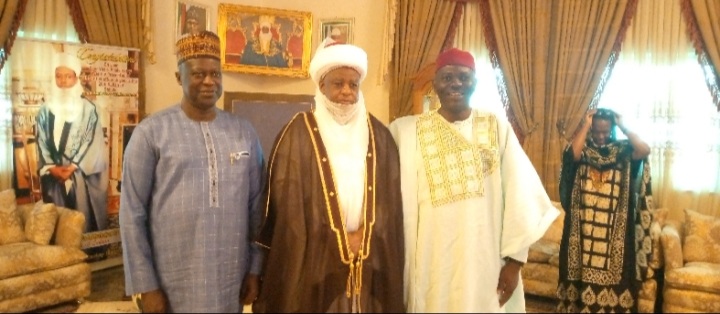





The Sultan of Sokoto and President General, Nigerian Supreme Council for Islamic Affairs (NSCIA), Alhaji Muhammad Sa’ad Abubakar III, has disclosed that poverty, rather than the desire to acquire Islamic education, is responsible for the practice of some parents sending their wards to other places as Almajiri.
The revered royal father stated this when Mr Ibrahim Sessey, the UNICEF-Nigeria, Chief of Child Protection, Mr Ibrahim Sessey, in company of Maryam Sa’ead, the Chief of Field Office in charge of Sokoto, Kebbi and Zamfara States alongside Mr Pius Uwamanua, UNICEF, Sokoto Field Office Child Protection Specialists, Dr. Godwin Odo, Child Protection Specialist, Abuja and other staff of UNICEF paid a courtesy visit on him at his palace in Sokoto.
According to Sultan, the religion of Islam protects the child and women more than any other religion, saying that seeing the children roaming the streets aimlessly has been a source of concern to him and the state government.
The respected religious and traditional leader therefore stated that, “Majority of those that are doing Almajiri cannot go to school because of poverty not really because they wanted it that way”.
The Sultan then said, “Our children’s lives are of great concern to us. We are passionate about educating them. We will put in everything because they are important to us. We feel sad anytime we go round and see them roaming about the streets.
“But the issue is that not all of those out of school children you see roaming about are Almajiri students but poor people seeking for food”.
Clarifying that the scenario often makes some to mistake Almajiri for beggars, the Sultan said that, “Almajiri is simply an Arabic word for someone that leaves his place in search of knowledge”.
The royal father also faulted the rationale behind sending minors to other places in search of Islamic Education when those responsible for the act in their childhood days, acquired same within their locality and enjoy parental care.
On the efforts being made in conjunction with the Sokoto State Government towards remodeling the Almajiri concept, the Sultan said about 100 schools have been built where the Malams will teach Almajiris to enable them get Western Education and the Qur’anic Education.
The Sultan also disclosed that the stakeholders want the Almajiris to start learning with computers as well, adding that it is going to be a very tough plan due to paucity of funds. He, however, said that the task is achievable.
Speaking earlier in her opening remarks, the UNICEF Sokoto Chief of Field Office, Maryam Sa’ead, noted that the wellbeing of children is of great importance to UNICEF.
She further requested the support of the Sultan for quality engagement with the Sultanate focal persons on birth registration, health, nutrition and education, including equitable access to education for all including the Almajiri and vulnerable children
On his part, the UNICEF-Nigeria Chief of Child Protection, Mr Ibrahim Sessey, said UNICEF will always continue to appreciate the contributions of traditional and religious leaders as well as other stakeholders in their quest towards guaranteeing a secure future for the children.
Sessey further appreciated the Sultan for his continued royal guidance which led to the realization of Child Protection Law being domesticated in Sokoto.
The UNICEF Country Chief of Child Protection however solicited the support of Sultan in supportting the convening of a state wide consultation with Malams, religious leaders, the Sokoto State Zakat and Endowments Commission and Arabic and Islamic Education Board and others to support reunification and reintegration of children including the provision of Qu’ranic education in locations where these are reunified.
He also requested for mobilization of community and state resources to match UNICEF funds for the programme, support advocacy efforts for the state governor to allocate and disburse funds to the programme as well as ensuring reunification for Almajiri living without parental care.
He added that the development will assist the Almajiris in keeping in touch with their families to make sure they live in the right environment and ensure social cash transfer programme for Almajiri pupils.
Sessey further stated that UNICEF has concluded plans to make sure that 12 million young people have access to digital skills, adding that there will be beneficiaries from Sokoto as well.