
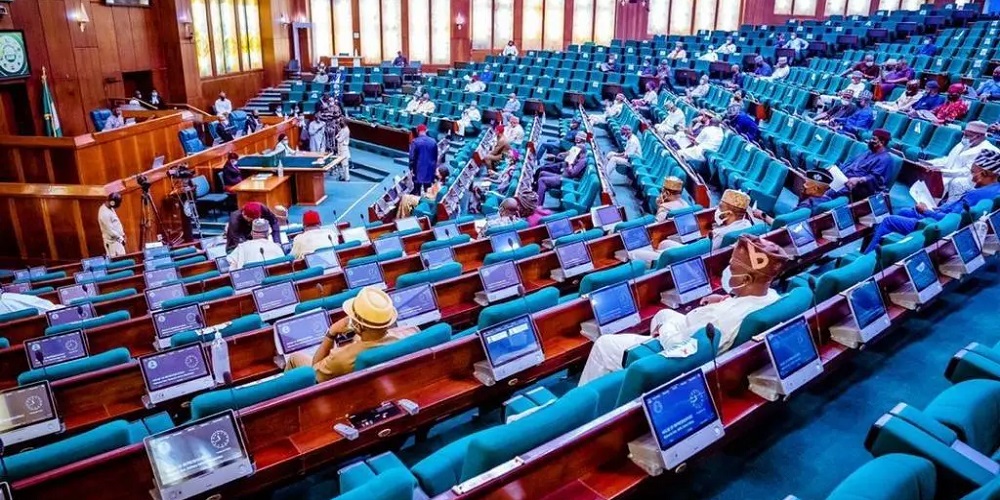





The House of Representatives has tasked its Committees on Finance, Petroleum (Upstream and Downstream) to probe reports from the Revenue Mobilisation Allocation and Fiscal Commission (RMAFC) which alleged that the Nigerian National Petroleum Company Limited (NNPCL) withheld N8.48 trillion as petrol subsidy claims.
Additionally, the House will investigate claims from the Nigerian Extractive Industries Transparency Initiative (NEITI), which reported that NNPCL failed to remit $2 billion (approximately N3.6 trillion) in taxes to the federal government.
The committees have been directed to verify the total cumulative amount of under-recovered revenue from the sale of petrol by NNPCL between 2020 and 2023.
This move comes as the House approved the 2025-2027 Medium-Term Expenditure Framework (MTEF) and Fiscal Strategy Paper (FSP) in preparation for President Bola Tinubu’s presentation of the 2025 Appropriation Bill next week.
MTEF is a multi-year expenditure plan that sets budgetary and fiscal targets, while FSP outlines the country’s fiscal policy framework.
President Bola Tinubu had earlier transmitted the MTEF/FSP to the National Assembly on November 19, 2024, after the Federal Executive Council’s approval.
The government has set the 2025 oil benchmark at $75 per barrel, with oil production projected at 2.06 million barrels per day.
The exchange rate parameter has been pegged at N1,400 per dollar, with a projected Gross Domestic Product (GDP) growth rate of 6.4%.
Debate on oil benchmark
Meanwhile, the debate over the $75 per barrel oil benchmark for 2025 has generated some controversy.
Minority Leader, Kingsley Chinda, called for the retention of the 2024 oil benchmark of $77.96 per barrel, pointing out that the country surpassed this figure in the first quarter of the year, with prices reaching $85.
He argued that a lower figure could be unrealistic in light of current trends.
But Abiodun Faleke, Chairman of the Finance Committee, defended the $75 benchmark as reasonable, noting that crude oil prices fluctuate and that the market may stabilize in 2025.
He emphasized that projecting a higher figure could lead to inflated expectations, as prices had recently dipped to $74 per barrel.
The debate concluded with the approval of the $75 oil benchmark, supported by other members who recognized it as a working document that could be amended if necessary.
Another area of concern was the projected increase in domestic oil production from 1.78 million barrels per day (mbpd) in 2024 to 2.06 mbpd in 2025, and further increases in subsequent years. Chinda expressed doubts over the feasibility of achieving these targets, given the current production levels.
As of the latest reports, Nigeria’s oil production stood at 1.05 mbpd.
Faleke, however, justified the projection, pointing out that production was improving, and pushing for more ambitious targets would encourage operators to work harder and secure more funding for the country.
The proposed exchange rate of N1,400 to the dollar over the next three years also drew scrutiny, with lawmakers questioning the volatility of the naira and the challenges of a weakening currency.
Concerns were raised about the implications for borrowing and national debt, especially as the country shifts toward more sustainable energy sources.
The House adopted inflation rate projections of 15.75% for 2025, 14.21% for 2026, and 10.04% for 2027, reflecting a gradual decline in inflation.
The House also approved the 2025 federal budget proposal, which outlines a total spending plan of N47.9 trillion, with N34.82 trillion allocated for retention.
New borrowings are set at N9.22 trillion, including both domestic and foreign loans.
The budget includes N16.48 trillion for capital expenditure, N4.26 trillion for statutory transfers, and N430.27 billion for sinking funds.
The discussion highlighted the importance of prudent fiscal management as Nigeria navigates its economic challenges and continues its energy transition.












 to probe reports from the Revenue)