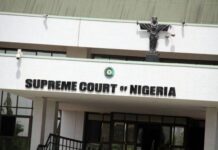





The Supreme Court, on Thursday, affirmed the elections of three state governors: Siminalayi Fubara (PDP, Rivers); Agbu Kefas (PDP, Taraba) and Ahmed Aliyu (APC, Sokoto), saying that the governors were duly elected during the March 18, 2023 governorship elections in their different states.
Rivers: APC, Tonye Cole v. PDP, Gov Fubara

In the first appeal to be decided, the five-member panel of the apex court in the lead judgment delivered by a Justice of the Supreme Court (JSC), Justice Ibrahim Saulawa, affirmed Fubara’s election and dismissed the appeal by the All Progressives Congress (APC) and its governorship candidate, Tonye Cole for being incompetent and lacking in merit. JSC Saulawa also held that the appellant did not prove his allegations of over-voting, non-compliance as well as non-qualification of Fubara to contest the election.
The JSC then said, “This appeal is grossly lacking in merit and liable to be dismissed and it is accordingly dismissed”. The apex court subsequently affirmed the concurrent judgments of the two lower courts which earlier dismissed the appeal for lacking in merit.
Tonye Cole had in his appeal, asked the apex court to reverse both the Court of Appeal and tribunal judgments which had upheld the declaration of Fubara of the PDP as winner of the March 18, 2023 governorship election in Rivers State.
The APC governorship candidate had claimed that the lower court erred in law when it agreed with the Rivers State Governorship Election Petitions Tribunal that he did not prove his allegations against the governorship poll. Cole also urged the apex court to allow his appeal and grant the reliefs sought which included the setting aside of the concurrent judgments of the two lower courts and declared him winner of the March 18 governorship election in Rivers State.
It is instructive to note that the Independent National Electoral Commission (INEC) had declared PDP’s Fubara as governor, having won majority of the lawful votes cast at the governorship poll. Dissatisfied, APC and Cole cited alleged irregularities, non-compliance with the Electoral Act, corrupt practices amongst others and asked the tribunal to void Fubara’s election as governor.
They further had claimed that Fubara was not qualified to contest the election over alleged violation of the law because he had allegedly continued to sign documents as the Rivers State’s Accountant-General despite been nominated governorship candidate of the PDP.
But the tribunal in a unanimous judgment, held that the allegations were not proved to warrant the grant of the reliefs sought and subsequently dismissed it. Dissatisfied, APC and Cole also approached the Court of Appeal for redress, asking it to reverse the judgment of the tribunal.
But the appellate court held that Cole did not advance any cogent reason to warrant it to deviate from the findings and conclusion of the tribunal. While the candidate of the Labour Party (LP) withdrew her appeal shortly after it was filed, the apex court had last few days ago, dismissed the appeal by the Allied Peoples Movement (APM).The appeal was dismissed following its withdrawal by the APM’s lawyer, Confidence Kere. When the case of the APM was called, its lawyer, Kere attempted to adopt and argue its client’s case.
But Kere was cut short by the panel led by Justice Kudirat Kekere-Ekun, who pointed out that the APM lacked the legal standing to institute the appeal on the grounds that it did not take part in the actual election.
Kere subsequently applied orally to withdraw the appeal and since the respondents did not object to the withdrawal, the apex court subsequently dismissed it.
Taraba: NNPP, Sani v. PDP, Gov Kefas

In a related development, the Supreme Court, in another unanimous judgment, delivered by the JSC, Justice Garba Lawal, affirmed the election of PDP’s Kefas as Taraba Governor and dismissed the appeal by Yahaya Sani of the New Nigerian People’s Party (NNPP) for being incompetent and lacking in merit.
JSC Lawal also pointed out that the appellants did not provide any tangible evidence to show that the two judgments of the Court of Appeal and Taraba Governorship Election Petition Tribunal were perverse in dismissing their case.
According to Justice Lawal, the Court of Appeal was right in holding that the case of the appellants was incompetent on grounds of incomplete transmission of the record of proceedings. The apex court subsequently affirmed the concurrent judgments that affirmed the declaration of Kefas as winner of the March 18, 2023, governorship election in Taraba State.
It is important to note that the Court of Appeal in Abuja, had last November, affirmed the election of Kefas as Governor of Taraba State. A three-member panel of the appellate court in two separate appeals had held that Kefas, was lawfully declared winner of the March 18 governorship election in Taraba State.
Delivering judgment in the appeal filed by Sani of the NNPP, the appellate court had held that the allegations of non-compliance, irregularities and other malpractices were not proved by the appellant. In a unanimous judgment delivered by Justice Peter Affen, the appellate court faulted the appellant for dumping documents on the court, stressing that even if there was manifest incidents of malpractices or irregularities on the face of the documents, the appellant ought to have led oral evidence to support his allegations. Besides, the appellate court dismissed the appeal for being incompetent and lacking in merit on grounds that the record of proceedings transmitted to the appellate court was not complete.
Delivering judgment in the cross appeal filed by Governor Kefas , the Court of Appeal struck out the appeal on the grounds that Sani was inconsistent in the reliefs sought in his petition. According to the appellate court, while the appellants had prayed for nullification of the election on grounds of non-compliance with the Electoral Act, they in another breath asked the court to pronounce them as winners of the same election on ground of scoring majority of lawful votes. The appellate court held that it was against the law for any litigant as in the case of NNPP and its governorship candidate to blow hot and cold at the same time.
Justice Affen further held that, having prayed that the election be nullified on account of non-adherence with the Electoral Act, the alternative prayer that, they be declared winner of the same election have no legs to stand upon. The appellate court subsequently allowed the cross appeal and struck out the petition.
A three-man panel of justices led by Justice G. A. Sunmonu of the Taraba state Governorship election petition Tribunal had on September 30 dismissed the petition filed by the NNPP and its governorship candidate for lacking in merit.
Sokoto: PDP, Umar v. APC, Gov Aliyu

The Supreme Court had also in another judgment delivered by the JSC, Justice Tijjani Abubakar, affirmed the election of Governor Ahmed Aliyu of Sokoto State and dismissed the appeal by the PDP and its governorship candidate, Saidu Umar.
In its unanimous judgment, the Supreme Court held that the appellants did not demonstrate that the two lower courts were perverse in their judgments and did not also show evidence of miscarriage of justice. Justice Abubakar subsequently dismissed the appeal for being incompetent and lacking in merit.
Umar and the PDP had listed nine grounds upon which they had asked the Supreme Court to set aside the concurrent judgments of the election petitions tribunal and the Court of Appeal which affirmed the election of Ahmed Aliyu as Sokoto State Governor.
INEC had in March last year declared Aliyu and his party, the APC winner of the Sokoto governorship election, having won majority of the lawful votes cast at the poll. Dissatisfied, Umar and PDP cited grounds of malpractices, non-compliance as well as non-qualification and urged the tribunal to void the election of Aliyu as governor.
On one hand, they prayed the tribunal to sack Aliyu and declare them authentic winner of the election, while on the other they had argued that the election be declared inconclusive and a rerun in about 138 polling units be ordered.
But, the three-member panel of Justices of the tribunal, led by Justice Haruna Msheila, in a unanimous judgment delivered on September 30, dismissed the petition for lacking in merit. The tribunal further held that the petitioners failed to prove the six grounds formulated in their joint petition.
According to the tribunal, the grounds stated in the petition bordered on alleged ineligibility of Aliyu and his deputy to contest, falsification of certificates, variation of names, election frauds and non-compliance with electoral guidelines.
The tribunal further held in its judgment that the petitioners were unable to prove the allegations beyond reasonable doubt as required by law, as 70 per cent of exhibits they tendered were out of context because they relate to State Assembly elections conducted on the same day.
Dissatisfied, Umar and PDP approached the Court of Appeal for redress while the appellate court in its judgment, affirmed the decision of the tribunal.
The three-member panel of the appellate court had in a unanimous judgment, held that the appellants failed to substantiate allegations of irregularities, noncompliance as well as non-qualification contained in their appeal.
It is instructive to note that Aliyu had won the election with about 49,000 votes, while total number of registered voters in the affected polling units where election was cancelled was put at over 85,000, total number of collected Permanent Voters Card (PVC) was put at over 82,000.
Based on the above, the appellants had urged the appellate court to void the election of Aliyu, declare the March 18 election inconclusive and that INEC should be ordered to conduct a supplementary election in the 138 polling units where election was cancelled.
They had presented INEC’s form EC40G (incident form; showing elections were cancelled due to over-voting or disruption.
But in its lead judgment, the appellate court noted that the form EC40G, “shows electorates were given opportunity to vote but something went wrong culminating in the cancellation of the election”. Stating that he doesn’t think it was necessary to call any person to speak again to such documents in line with Section 137 of the Electoral Act, Justice of the Court of Appeal (JCA), Justice Mbaba Bassi, who delivered the lead judgment, however, observed that precedence set by the Court of Appeal and the Supreme Court in related matters demand that the appellants lead oral evidence to support the allegation of manipulation of votes through the cancellation of election in 138 polling units. Based on this, JCA Bassi had held that the tribunal was right in expunging evidence of non-compliance and other alleged irregularities and malpractices because the evidences were presented by incompetent witnesses.
JCA Bassi further held that the failure of the appellants to list and front-load the statement of the witnesses was fatal to their case. Besides, the appellate court held that even though the appellants provided documents from INEC to prove cancellation of election in 138 polling units across the state, their failure to call witnesses from the affected polling units to speak to the documents was fatal to their case.
JCA Bassi pointed out that reliance on Section 137 of the Electoral Act, 2022, was insufficient to prove cancellation without oral evidence.
Regarding the issue of alleged certificate forgery, the appellate court similarly agreed with the tribunal that the appellants were unable to prove that the certificate submitted by the Governor and his deputy were forged.
Observing that allegations of forgery are criminal in nature and as such must be proven beyond reasonable doubt, the appellate court stated that failure of the appellants to provide both the forged and original certificates before the court was fatal to their case. Still dissatisfied , Umar and PDP approached the apex court, asking it to reverse the concurrent judgments of the two lower courts.