
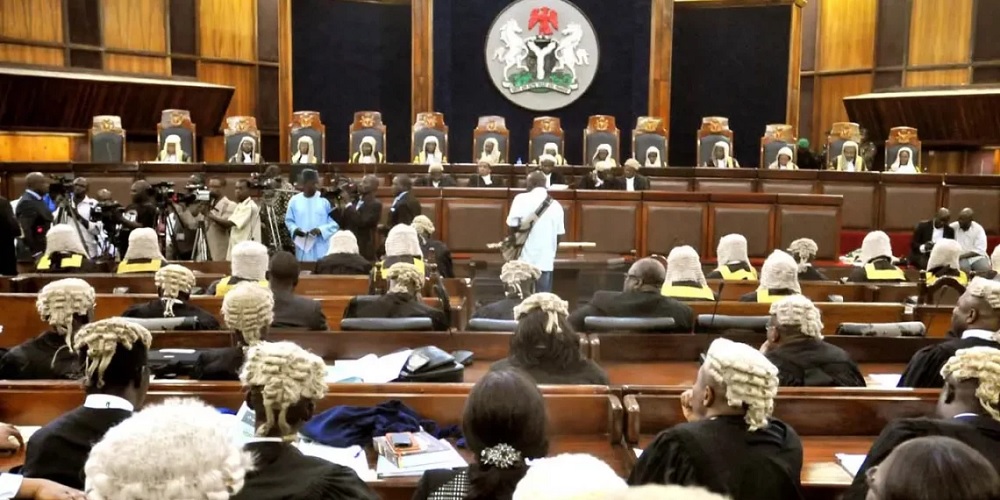





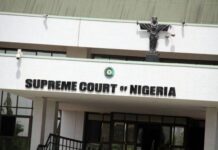
The Supreme Court, on Thursday, dismissed the appeal by the presidential candidate of the Labour Party (LP), Peter Obi, challenging the election of President Bola Tinubu.
The seven-member panel of the court led by Justice of Supreme Court (JSC), Justice Inyang Okoro, summarily dismissed Obi’s appeal on Thursday, saying the application raised substantially the same issues as that of the presidential candidate of the Peoples Democratic Party (PDP), Atiku Abubakar’s appeal which was earlier dismissed by the court.
The apex court also said in its unanimous judgement that the only different issue in Obi’s appeal, which is the allegation of the double nomination of Kashim Shettima as a vice-presidential candidate and a senatorial candidate in the February election, had been earlier resolved by the apex court and would not be allowed to be relitigated.
The judgement, coming immediately after the court’s decision dismissing Atiku’s appeal, brought the curtain down on the legal disputes over the validity of Tinubu’s election.
The Supreme Court further expressed its displeasure over the relitigation of Vice President Kashim Shettima’s double nomination issue.
Justice Okoro said, “This court cannot allow the issue of candidate’s double nomination to be relitigated in this court. There must be an end to litigation. This matter ought not to have come here. This appeal lacks merit and it is hereby dismissed.”
Concurring with the lead decision, a member of the panel and JSC, Justice Tijjani Abubakar, said the issue had “nothing useful to add to the appeal.”
In his contribution, Mohammed Garba said Obi’s grouse with the verdict of the presidential election court had been “comprehensively dealt with” in Atiku’s appeal.
Justice Garba said, “This appeal substantially canvasses same issues” in Atiku’s appeal.
Other members of the panel, Uwani Abba-Aji, Adamu Jauro, Ibrahim Saulawa and Emmanuel Agim, concurred with the lead judgement and dismissed Obi’s suit for lack of merit.
Obi had won a landslide in the FCT while neither Atiku nor Tinubu could garner the 25% votes in Abuja.
The LP candidate had urged the court to either declare him president or order a rerun election due to Tinubu’s failure to poll 25 per cent of lawful votes in Abuja.
But in his verdict on Thursday, Justice John Okoro, who delivered the lead judgment in Atiku’s appeal, held that acceding to Obi’s request would amount to a “narrow and selfish approach in interpreting the (Nigerian) constitution.”
The apex court queried why a presidential candidate with the highest number of lawful votes in an election should be denied victory for not securing 25 per cent votes in Abuja.
Justice Okoro explained that the court is duty-bound to give “a holistic and broad interpretation to the constitution.”
Agreeing with the submission of the lead lawyer to President Tinubu, Chief Wole Olanipekun (SAN), on the status of the FCT, Justice Okoro said, “The legislature does not intend to create injustice or absurdity” by conferring a special status on residents of the FCT above Nigerians in other states of the country by insisting that a presidential candidate must secure 25 per cent of lawful votes in Abuja before been declared winner of an election”.
Regarding the issue of INEC’s non-compliance with the Electoral Act in the conduct of the 25 February election, the Supreme Court held that Obi who came second in the race with 6.1 million votes did not prove that the allegation substantially affected the outcome of the election.
The apex court also adopted its position in Atiku’s appeal regarding INEC’s failure to electronically transmit polling unit results in real-time to the IReV, in determining Obi’s contention on the issue.










, Peter Obi, challenging)