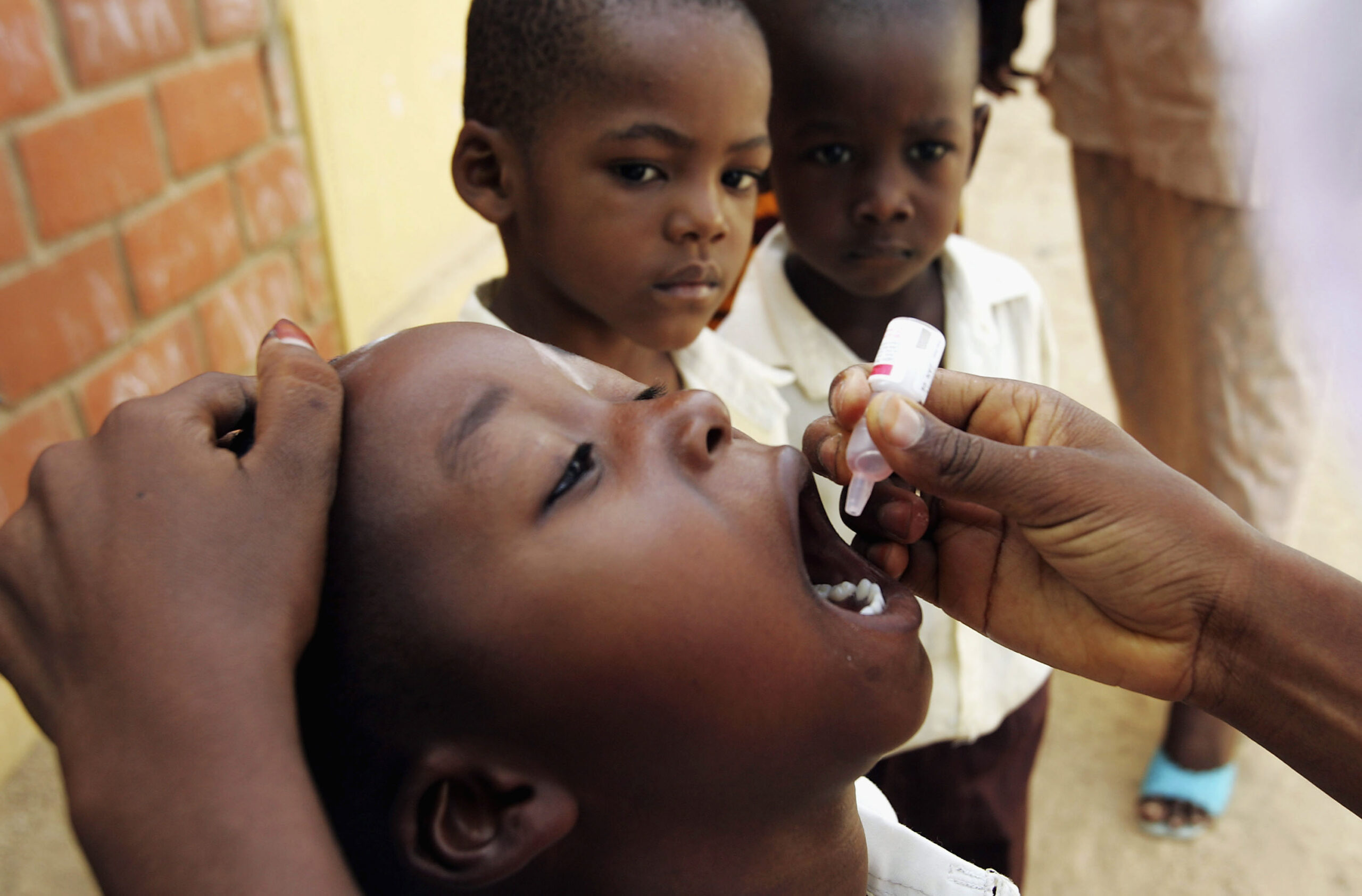





Despite the outbreak of the novel Corona virus pandemic, which has ravaged the whole world, the Federal Government has revealed that its surveillance on polio has remained strong.
The Federal Government added that its surveillance had in 2020 peaked and detected 22 cases of Circulating vaccine-derived poliovirus type 2 (cVDPV2), 1027 cases in 2021 while 11 cases have already been detected in 2022.
The Executive Director, National Primary Healthcare Development Agency (NPHCDA), Dr Faisal Shuaib, made this disclosure during the 38th Expert Review Committee (ERC), meeting on Polio and routine immunization in Abuja on Monday.
Shuaib, while stressing that the even though the figures might look scary, added that it is a demonstration that the surveillance system is effective and reliable to detect a Wild Polio Virus in circulation.
He said, “Our surveillance system has remained robust despite the global COVID-19 pandemic that had a negative impact on the health system. In 2020, our surveillance had picked and detected 22 cases of CDVPV2, in 2021, 1027 cases and in 2022, 11 cases have already been detected.
“Although the figures may look scary, it is a demonstration that our surveillance system is effective, reliable and also means that if there is a Wild Polio Virus in circulation, it would have been detected’’.
On Routine Immunization, the NPHCDA boss disclosed that the country has improved from 33 per cent coverage in 2016 to 56 per cent in 2022.
Quoting the latest MICS/NICS report, Faisal said, ‘’We recognize that before the pandemic, we had reached 71 per cent within two years.
“The cVDPV2, has been a major concern during the last ERC meeting, and today the outbreak has snow-balled to even greater proportions to become one of the greatest challenges the country has faced in the polio programme, apart from the recent detection of Wild Polio Virus type 1 (WPV1) in Malawi in February, and WPV 3 report in Israel this March. This brings it very close to home that it is not over until it is over. The report from Malawi indicates that we must strengthen our system in order to avoid an outbreak of WPV in Nigeria.
“The 37th ERC had offered us guidance on how to contain cVPV2 spread, which has unfortunately now spread more to affect 29 States of the federation and FCT, including states in the Southern zones of the country.
“One of this guidance was the use of novel Oral Polio vaccine (nOPV2) which has been shown to be effective in halting the spread of cVPV2. So far all 36 States and FCT have completed at least two rounds of nOPV2, 18 states have completed at least four rounds of nOPV2 Outbreak Response, 3 states have completed three rounds, while an additional 16 states have completed at least two rounds of nOPV2 Outbreak response’’.
Dr Shuaib added that about 19,316, 980 Nigerians have been vaccinated for covid-19 with first dose of the COVID-19 vaccine; 8,799,052 have taken second dose; while 725,459 have taken the booster dose.
Calling on Nigerians to present themselves for vaccination, he added that the figure vaccinated is a far cry from the government’s plan to vaccinate 50 percent of the total population of the country by the end of March 2022.
Earlier, Chairman, Expert Review Committee on Polio and Immunization, Prof Akin Osibogun, in his address, said the committee did a tremendous job for about 2 decades and succeeded in getting Nigeria certified wild Polio virus free.
He disclosed that the threat from recent report of the detection of the wild polio virus in Malawi is a call for concern, adding that all hands must be on deck.
He said, “With the recent wild Polio virus type 1 in Malawi it has become imperative for us to urgently put in place strategies to prevent importation of the virus. The reconstitution of this Expert review committee is one of such strategies and the leadership of the NPHCDA must be commended for being proactive.
‘’The objective cut for this committee is essentially to advise on strategies to prevent re-introduction of wild polio virus in Nigeria and end the circulating vaccine derived polio virus in Nigeria through strengthening of the immunization programme, AFP surveillance, community mobilization and advocacy, environmental monitoring and other appropriate strategies.
‘’I am confident that with this assembly of experts on the ERC, we will be able to achieve our goal which is to ensure all eligible children are reached irrespective of their location in the country’’.