




…whoever has imposed any barrier on his or her ability to comprehend what fintech is, as well as its value, both as a requirement and an index of growth and development, should get a copy of this book, read, and process it. Despite the extant challenges, the impact of fintech in Nigeria’s emergent digital economy sector has been astonishing across all sectors. I, therefore, recommend this book to all who seek information, knowledge and real development of Nigeria’s economy and the role of the human agency should play to bring it to reality.
Introduction
The emerging possibilities of the Fourth Industrial Revolution (FIR), as central organising principles of contemporary society, have been astonishing in their revolutionary bearings. Schwab (2017) had reasoned that emergent communication technologies will continue to impact the human experience beyond our current realities. Amplifying the rational voices of Giddens and Sutton (2013) and implicitly Castells (2009, 2015), I (Ibietan, 2023) had documented that the driving force of modern innovation is not just the technology. Modern communication is a product of the interface of technology and the human agency.
In other words, the notion of the digital economy and other signposts of the revolutionary uptake of communication technology, and essentialness of the duality of structure – technology and the human agency – in remaking or advancing the society.
The centrality of human agency, particularly the role of culture as an arbiter, in driving the digital economy, is underscored by people like Tim John Berners-Lee and our own, Dipo Fisho, who this festschrift honours. Fisho trained as a mechanical engineer at Edo State University and worked with leading construction firms, including Julius Berger, for a decade before going to the University of Hertfordshire to earn a Master’s degree in project management with a focus on payment and information technology.
Acknowledged as a leading Afrocentric change agent in the utilisation of digital technology, Fisho is a torchbearer in the payment technology space. For five years he worked with Brinq Africa Payment Limited, until he founded QuickPay Digital Solutions Limited, through which he has deployed many payment applications, including QuickPay App, QuickPay JED App, QuickPay EEDC App, QuickPay APL App and QuickPay KEDCO App.
These came after he had successfully built some 15 enterprise solutions or applications while at Brinq Africa Payment Limited. For more than two years, he successfully managed the Kogi State Internally Generated Revenue Services, among other feats driven by his innovations. Fisho’s contribution to the financial technology (Fintech) industry in Nigeria is seminal and profound.
The Book
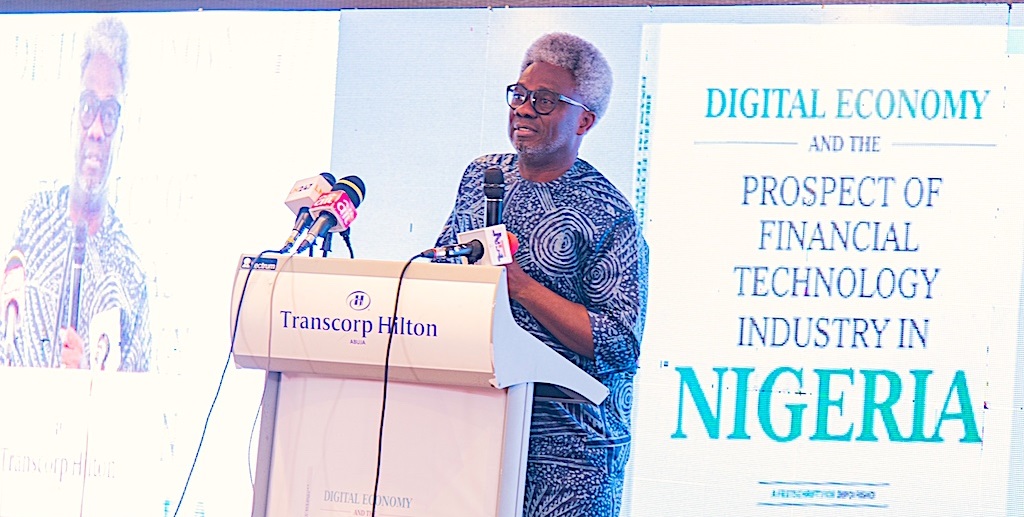
Digital Economy and the Prospect of Financial Technology Industry in Nigeria is a reader, an anthology of writings running through the gamut of rational, fundamental themes within the framework of digital economy. The book is edited by four intellectually agile scholars led by Professor Rufus Ajisafe, head of department of Economics at Obafemi Awolowo University, Ile Ife.
The other editors, Dr Ola Kehinde, Dr Daniel Onyejiuwa and Doctoral Fellow Rachel Fagboyo are of the Department of Economics at Glorious Vision University (formerly Samuel Adegboyega University), Ogwa, Edo State, which is a tertiary educational institution of The Apostolic Church of Nigeria.
Some thirty contributors, including Fisho, the Vice Chancellor of Glorious Vision University (publishers of the book), scholars and professionals beyond Nigeria, have penned down their thoughts under different relevant themes and in acceptable scholastic traditions that speak to the essence of digital economy and financial technology. Among them is my very dear younger brother and colleague, Kunle Olorundare, an engineer and principal manager at the Nigerian Communications Commission.
From the Foreword written by Major General Isaiah Allison (PhD) to the introduction by the Vice Chancellor of Glorious Vision University, and the incisive treatment by all contributors, digital economy is understood as the application of modern communication technologies to the hitherto existing practices in the economy, such as production, distribution and trading. Otherwise, it would mean the processes through which goods and services are distributed through digitised culture, including online platforms.
However, as captured in the book from pages 7 to 13, the above definitions could have three dimensions, namely: Products (goods and services) must be ICT-compliant and possess digital content and digitally delivered services; the production process must rely largely on “digital inputs” and possess digital compliance; the transaction chain must be digitally delivered, and there will be a relatively zero freight cost across borders. Accordingly, three definitional foci – the core, narrow and broad definitions of digital economy – were identified, each subsuming the preceding and expanding the scope.
In conceptualising digital economy, the book offers tens of the definitions advanced by a galaxy of authors and contends that digital economy can also be defined by measurements based on the framework developed through the UN Statistical Commission. This conception, which I find quite useful and explanatory, could focus on products, production, and transactions.
The product dimension would include trade in ICT goods, in terms of smart items (phones, computers, other appliances), trade in ICT services (online banking and other financial services, Zoom or Teams meetings, lectures, online customer care), trade in ICT enabled services that are digitally delivered, such as bookings, sales, and online payments.
The production dimension would entail the ICT sector (employment and other value-addition such as the telecom industry, social media, and others), and the ICT usage in business (substantial reliance of other sectors on ICT processes). The third measurement would encompass transactions (e-commerce (online transactions) and e-business (all web-based services generating revenue or other non-financial benefits), as well as e-governance, e-marketing, e-media and so on.
Nevertheless, the pivot of conception is that these practices have been enabled by computing and the Internet, thereby guaranteeing real time access to information and informational resources such as apps, digital wallets and an assortment of mobile solutions.
Therefore, financial technology (fintech) are those apps, software and technologies that are automated to enable individuals, business owners, corporations, institutions and governments to manage and improve their financial activities more efficiently.
To be clear from the outset, this book is a delight to read and quite consequential. Every contributor has offered an informed and seminal work done in contexts and within visions that enable us to acquire knowledge, as well as process and apply the knowledge to harvest every derivable benefit of the digital economy.
Besides its 27 preliminary pages, which are also spiked with valuable information, this is a 404-page book organised into four thematic foci (Digital Economy, Fintech Industry, IT and New Technology, and Data Science). These four sections are unbundled in 25 chapters.
The book raises the banner of the potentials of digital economy, beginning with an introduction by Professor Ezekiel Asemah, who engages in a synoptic analysis of the book and applauds the painstaking thoroughness and practical application of its treatise.
To harvest the huge benefits lurking in the digital economy sector, Asemah advocates stakeholders’ intervention toward addressing the challenges of uneven growth, inadequacy of digital infrastructure, obstacles in the regulatory environment, cybersecurity concerns, financial inclusion, and the imperative of strategic collaboration among state and non-state actors.
One of the elephants in the room in discourses on the digital economy is cybercrime and cyber security. It is, therefore, pleasing that this book devotes Chapter Seven to that topic. Reiterating that cybersecurity breaches can cause the loss of customer information, financial loss, as well as reputational damage, this new literature documents patterns of cyber threats and how to safeguard networks from vulnerabilities.
In the 25 chapters, various contributors make key conceptual clarifications, and elucidate on key elements in the digital economy ecosystem that constitute enablers of fintech and features of the modern society that signpost the digital economy, including mobile banking, robotics, blockchain technology, cryptocurrency, big data, the Internet of Things (IoT), online commerce and distribution, social media and numerous electronic activities in the spheres of education, agriculture and health, among others.
The World Bank taxonomy of e thfoundational pillars of digital economy is put in context within the framework of Digital Economy for Africa (DE4A) namely: digital infrastructure, digital platforms, digital financial services, digital entrepreneurship, and digital skills. We glean from the book about how COVID-19 strengthened the digital economy globally. This underscores the extant literature and experience we all directly encounter.
This book reiterates the value of money, its origin, the evolution of banking, as well as barter and exchange systems in Nigeria, the colonial currency, emergence of the Nigerian currency, impact as well as challenges of money in Nigeria, while emphasising that money has played a crucial role, right from the integration of the Nigerian economy, with the British imperial economic structure. However, there is a demand to combat counterfeit currencies, promote financial inclusion, implement effective monetary policies, and the necessity to integrate the formal and informal sectors to institute robust monetary systems in Nigeria.
Expectedly, the book reflects on the cashless policy in Nigeria from the perspective of the card system, mobile payments, digital wallet and cryptocurrency, whilst exploring their importance and challenges. This book does not mince words in describing the recent redesign and demonetisation of the naira as ill-advised and disastrous. It recommends that interest rates and money supply need to be managed in a more efficient manner.
It further suggests, and objectively so, that the success of the cashless policies will depend on realistically addressing the needs of all stakeholders, the overhauling of infrastructure, and continuous expansion of the digital infrastructure, with guaranteed data protection.
This anthology also explores in detail, the concept and nature of cryptocurrency, cryptoassets, metaverse and bitcoin. It explains their mechanisms and places them in contrasts and describes the computer-generated currencies as valuable for transactions. It reveals how underlying blockchain technology and innovation have helped to demystify the complexities of these digital assets and recommends that “clear, timely and effective regulations” are required to optimise the derivable benefits of these digital assets.
What are the implications of the culture of the digital economy on business operations? Exploring the key aspects of the intersection, this book documents online presence, commitment to e-commerce, digital marketing, data analytics, agile operations and virtual collaborations, exploration of platform-based business models, empathetic customer engagements, and focus on continuous innovation as irreducible actions for businesses that want to flourish in the emergent digital economy.
This new addition to the growing corpus of literature on the digital economy gratifies the reality of ICT adoption in retail business, transport and logistics, financial services, education, manufacturing and agriculture, health, media and broadcasting, among others, as significant. It notes that the development saves time, reduces the cost of operation, nudges personalised services, lowers entry barriers and creates significant data, but it also curates the concerns about privacy issues, the addictive nature of technology, tendency for monopoly, disruption challenges, increased loss of the sense of community, and the fact that the digital economy does not necessarily lead to green solutions, contrary to the belief in some circles. So, to the authors, these are red flags to watch.
Yet, in the book, a relative analysis of cloud accounting seals the relevance of digitalisation to the accounting practice. From the analysis, while the application of technology in accounting dates back to seven decades, the digital economy reality of contemporary society has caused a positive, revolutionary shift in the accounting practice and financial systems, more than during any other period.
Drawing parallels between traditional accounting and modern practices enhanced by the digital economy, the book notes that despite the threats to data security and other challenges associated with digitisation, cloud accounting has enabled practitioners to work from any location, ensure the maintenance of financial information, and enhance the faster processing of tasks, including the real time detection of issues.
One of the elephants in the room in discourses on the digital economy is cybercrime and cyber security. It is, therefore, pleasing that this book devotes Chapter Seven to that topic. Reiterating that cybersecurity breaches can cause the loss of customer information, financial loss, as well as reputational damage, this new literature documents patterns of cyber threats and how to safeguard networks from vulnerabilities.
From a broad conceptualisation, clarification and explanatory offering of financial technology, the book equally attempts an informed overview of fintech practices in Nigeria in the context of the global economic systems. This overview was done by Fisho. He informs that over a 500 per cent increase was recorded in inflow to startups between 2021 and 2022.
He equally documents the transition of three startups – Flutterwave, Opay and Andela – to unicorn status, having hit a USD$1 billion in the period. Nigeria’s fintechs also witnessed greater collaboration, among which was Flutterwave’s collaboration with Paypal and Carbon’s with Visa. The period also witnessed the birth of new banking models targeted at the unbanked and enhancing access to financial solutions by those in unserved and underserved areas of Nigeria.
Besides the three hitherto mentioned leading start-ups, the key players in the fintech industry in Nigeria include Paystack, Interswitch, Cowrywise, Piggybank, Paga, KongaPay. The challenges to robust fintech utilisation were also captured, as well as matters in the regulatory and legislative environments.
Citing Ernst and Young (2020), Fisho states that the payment sub-sector experienced the fastest growth, representing 38 per cent of market solutions, and there is cause for optimism in the future.
According to Fisho, beyond core payments, stakeholders look forward to a robust and ambitious fintech infrastructure that provides non-core financial services in other sectors, including energy, insurance, healthcare and education. He cites a fitting example of Kenya, where M-Pesa’s payment infrastructure delivers payment for solar and healthcare services.
The argument is also offered that the challenges to fintech with regard to insurance would be overcome with deeper penetration and increase in trust levels. Fisho notes that increase in mobile penetration would serve to deepen the penetration of insurance products and heighten the growth of the industry.
Of particular interest to me is Fisho’s exposition on niche-focused players, such as the emergent platforms, where he references “platforms empowering the education sector to increase access to student loans, grants, and payments to educational institutions.” I am also delighted to note that the MTN and Airtel foray into financial services is within the scope of this book.
As noted elsewhere, a digital economy can only be as animated as the pattern and degree of literacy of its citizens, and it is so gratifying that Dr Tijani gave expression to the centrality of literacy and empowerment with the ongoing Three Million Technical Talent (3MTT) programme, through which Nigeria will reflate its human capital development and export digital talents. I believe Nigeria will surpass the target if we activate the implementation of the National Digital Literacy Framework 2023.
It is delightful that the book emphasises the imperative of regulation and institutional frameworks, as well as collaboration, especially among the Central Bank of Nigeria (CBN), the Nigerian Deposit Insurance Corporation (NDIC), Corporate Affairs Commission (CAC), Securities and Exchange Commission (SEC), Nigerian Communications Commission (NCC), National Information Technology Development Agency (NITDA), National Insurance Commission (NAICOM) and many others, including innovation hubs and incubators. The role of collaboration cannot be over-emphasised. As the book evidences, the Nigerian Financial Inclusion Strategy would not have been a success nor taken off without the collaboration of CBN and NCC.
As emphasised in the book, there must concerted efforts towards applying technology in human resource management at all levels of business or organisation and the regular upskilling of people to enable them leverage every emergent application in the context of its relevance to the growth and development of the nation’s economy.
The ongoing interest in deepening the application of Artificial Intelligence, especially the recently commissioned studies by Minister Tijani, resonates with the thesis of the book, where types and benefits of AI are showcased for exploration. Harnessing technology on all fronts increases Nigeria’s capacity to provide employment and empower the citizenry, particularly the young people who are more prone to exploitation and manipulation in ways that undermine national security.
The value of data as a guide to several opportunities was discussed by some contributors in the concluding section of the book, which is devoted to data issues. What constitutes big data that can be mined and transformed for great purposes? As asserted in the book, data is the future because it is always a key raw material required for production in a digital economy.
Reading this book teaches that data analysis transcends statistics. It includes prognosis about emerging trends, patterns of their evolution and how all that serve as guide for managers and leaders to make informed, objective decisions to enhance success and spur interest in entrepreneurship.
Conclusion
By virtue of being Africa’s most populous country, its largest market, and accounting for almost a third of the continent’s internet usage, Nigeria’s e-commerce spending is projected to hit $75 billion by 2025 – just next year. Two years ago, the digital economy’s contribution to Nigeria’s GDP was approaching 20 per cent.

In a recent initiative I carried out for the global office of Mastercard Foundation, I cited these evidence-based statistics and asserted that these figures, as they speak to projections and accomplishments, could be underestimations, given the multiplier effects, cross sectoral or multisectoral aspects of the digital economy.
By my reckoning, there are points within sectors that are not fundamentally tech-driven and therefore not captured. We need to identify them and get them to leverage technology. A major concern is increasingly the low level of foreign direct investment.
Do we have alternate sources of funding seminal infrastructure projects? We need to put on the thinking cap to see how to get funds to invest in areas requiring such, like the expansion of digital infrastructure. Finally, will the success of the fintech market be impaired by talent, capital, demand and regulation, as forecasted by Ernst and Young (2020)?
The last question was partly envisioned in Pillar Two of the extant National Digital Economy Policy and Strategy (NDEPS) 2020-2030. Thankfully, the NDEPS resonates in a more concrete, pragmatic sense with the strategic blueprint released in October 2023 by the Honourable Minister of Communications, Innovation and Digital Economy, Dr Bosun Tijani, who, in centralising knowledge as an organising principle, is taking the bull by the horn.
As noted elsewhere, a digital economy can only be as animated as the pattern and degree of literacy of its citizens, and it is so gratifying that Dr Tijani gave expression to the centrality of literacy and empowerment with the ongoing Three Million Technical Talent (3MTT) programme, through which Nigeria will reflate its human capital development and export digital talents. I believe Nigeria will surpass the target if we activate the implementation of the National Digital Literacy Framework 2023.
Suffice it to say that we need to organise afresh, engage more strategically and collaborate. In other words, the Nigerian government and the Honourable Minister need all the support they can get. As my boss, the Executive Vice Chairman/Chief Executive Officer of NCC, Dr Aminu Maida, who chairs this occasion has said repeatedly, we should be decidedly dedicated to the implementation of Minister Tijani’s strategic plan, tagged, “Accelerating Our Collective Prosperity through Technical Efficiency.”
We all have roles to play in this regard. Without citizens’ participation there will be no development. Participation is precisely what the contributors to this book have done – they have engaged us with their thoughts and we have an obligation to act appropriately.
Therefore, whoever has imposed any barrier on his or her ability to comprehend what fintech is, as well as its value, both as a requirement and an index of growth and development, should get a copy of this book, read, and process it.
Despite the extant challenges, the impact of fintech in Nigeria’s emergent digital economy sector has been astonishing across all sectors. I, therefore, recommend this book to all who seek information, knowledge and real development of Nigeria’s economy and the role of the human agency should play to bring it to reality.
Omoniyi Ibietan is the head of Media Relations at the Nigerian Communications Commission (NCC).
This is the text of a review of the book Digital Economy and the Prospect of Financial Technology Industry In Nigeria: A Festschrift for Dipo Fisho held at the Transcorp Hilton Hotel, Abuja.