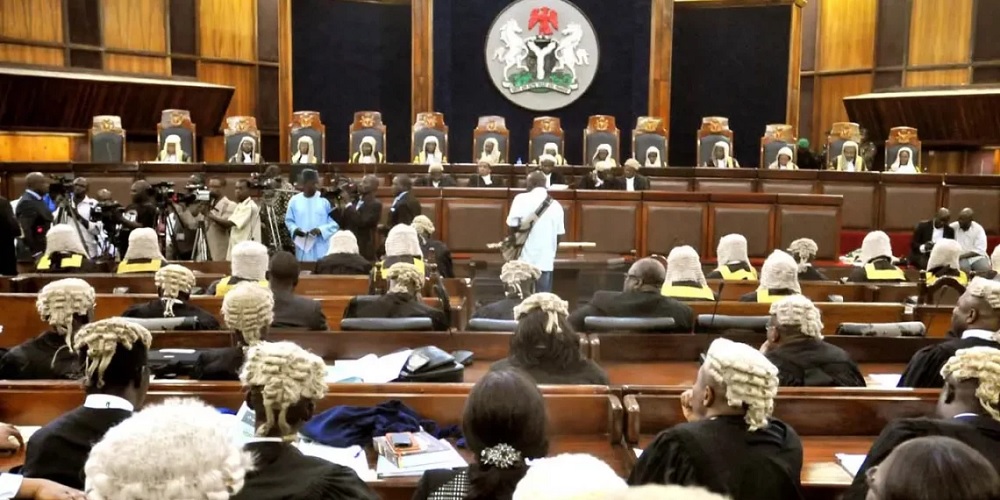





*As Local Councis finally get financial autonomy
In what can be considered as unprecedented and a new dawn for grassroots development, the Supreme Court, on Thursday, directed the Federal Government to henceforth pay federal allocations from the federation account directly to the 774 Local Government Areas (LGAs) in the country.
Delivering a landmark judgment in the suit by the Federal Government against the 36 State Governors, a seven-member panel of the apex court led by a Justice of the Supreme Court (JSC), Justice Emmanuel Agim held that state governments have continued to abuse their powers by retaining and using the funds meant for LGAs.
The Federal Government had in May, filed a suit at the apex court against governors of the 36 states.
In the suit marked SC/CV/343/2024, the federal government asked for full autonomy for the country’s 774 local governments.
In the suit filed by the Attorney- General of the Federation (AGF) and Minister of Justice, Prince Lateef Fagbemi (SAN) against the 36 State Governors through their Attorneys-General, the Federal Government also requested the apex court to authorise the direct transfer of funds from the federation account to local governments — in accordance with the 1999 Constitution (as amended).
Granting full financial autonomy to the 774 local governments in the country, the Supreme Court, in a unanimous decision, outlawed the appointment of caretaker committees to administer the local governments by state governors.
The panel also declared that it was illegal and unconstitutional for governors to continue to receive or retain funds allocated to the local councils, under State and Local Government Joint Account.
With this this development, the governors’ control of the 774 councils’ allocation has been halted while several states without elected local government officials may have their council allocation withheld.
In the originating summons, the AGF prayed the court to order the direct allocation of funds from the federation account to the local governments.
He also sought an order prohibiting the unlawful dissolution of local government administration and the state governors’ appointment of caretaker committees to run the councils.
The instant suit was hinged on 27 grounds that the constitution of Nigeria recognises federal, state and local government as three tiers of government.
It is instructive to note that all the governors opposed the suit and urged the apex court to strike out the case for being grossly incompetent.
They further claimed the the AGF lacked the locus standi to institute the suit for the local governments.
But in the lead judgement delivered by Justice Emmanuel Agim, the apex court declared that the government was portioned into three tiers-federal, state and local governments.
The court further declared that a state government had no power to constitute a caretaker committee, saying that a local government council is only recognisable with a democratically elected government.
JSC Agim said, “A democratically elected local government is sacrosanct and non-negotiable,’’ thus putting an end to the infamous practice of appointing caretaker committees to run the councils by the state governors.
The apex court also held that the use of a caretaker committee by the state governments to administer the local government violated the 1999 Constitution.
The Supreme Court further held that the LGAs should be governed by a democratically elected government but “the states by the abuse of their power has worked against this law.”
The court declared that the 36 state governors had no power to dissolve democratically elected local government councils to replace them with caretaker committees, saying
“such an act is unlawful, unconstitutional, null and void.”
The apex court also barred the state governors from receiving, retaining or spending the local government allocation.
According to the Supreme Court, the practice of receiving and retaining local government funds by the states had gone on for too long, saying that it was a clear violation of section 162 of the 1999 Constitution, as amended.
The apex court held that the 1999 Constitution (as amended), states that any money leaving the federation account must be distributed to the three tiers of government, adding that the local government administrations should receive and manage funds meant for the local councils.
JSC Agim also directed as follows , “I hold that the state’s retention of the local government funds is unconstitutional. Demands of justice require a progressive interpretation of the law. It is the position of this court that the federation can pay LGA allocations to the LGAs directly or pay them through the states.
“In this case, since paying them through states has not worked, justice of this case demands that LGA allocations from the federation account should henceforth be paid directly to the LGAs.”
Granting other reliefs sought by the Federal Government, JSC Agim said, “A declaration that the local government council funds must be paid to only democratically elected local government council. Anything other than this will be taken as a gross misconduct.”
Other reliefs granted include “a declaration that the state government has no power or control to keep the local government council money or funds.
“A declaration that the local government council is entitled to the local government allocation.’’
The Supreme Court also granted “An order of injunction restraining the defendants by themselves, agents or privies from spending local government allocation.
“A declaration that no state government should be paid any money meant for the local government; an immediate compliance to this judgement.”
The Supreme Court had earlier dismissed the preliminary objection of the state governors, describing the application as frivolous.
The apex court also held that as the chief law officer of the federation, AGF Fagbemi has the right to sue in the public interest to protect and enforce public laws.
The apex court added that the AGF also has every right to file the suit as the subject matter of the suit is not speculative, saying that he also has the right to protect the 1999 Constitution and prevent any government features from going extinct.
JSC Agim finally held thus, “I hold that the plaintiff’s request is hereby approved and all the reliefs granted.”