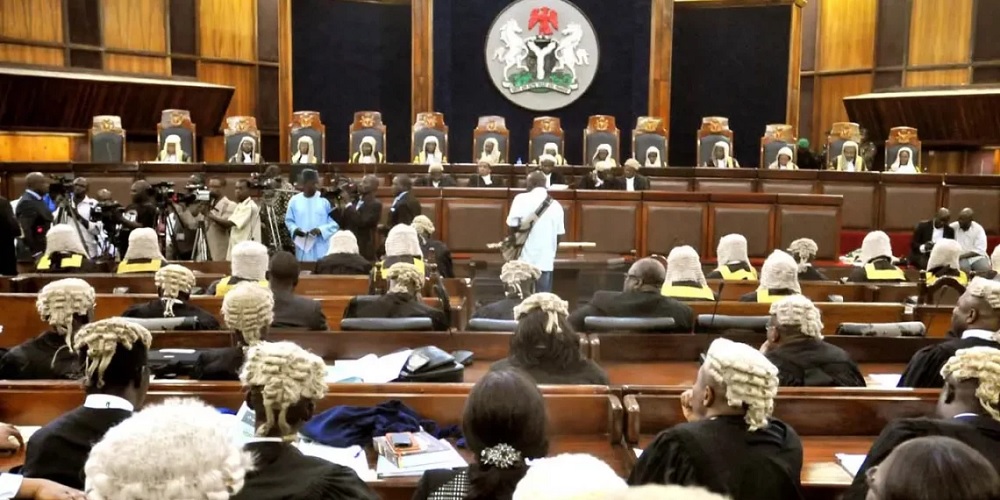





The Supreme Court, on Friday, dismissed the suit filed by Kogi and 15 other state governments, challenging the legality of the laws establishing the Economic and Financial Crimes Commission (EFCC), the Independent Corrupt Practices and Other Related Offences Commission (ICPC) and the Nigerian Financial Intelligence Unit (NFIU).
In a unanimous judgment delivered by a seven-member panel led by a Justice of Supreme Court (JSC), Justice Uwani Abba-Aji, the apex court held that the suit was unmeritorious.
JSC Abba-Aji had earlier dismissed the preliminary injection by the AGF against the suit, saying that the Supreme Court had the jurisdiction to hear the matter.
The Supreme Court further resolved the six issues raised for determination in the suit against the state governments.
The apex court also held that the laws establishing the anti-graft agencies were validly enacted by the National Assembly within its legislative competence.
The Supreme Court further faulted the claim by the plaintiffs that the EFCC Act, being a product of the United Nations convention on corruption, ought to be ratified by majority of the state Houses of Assembly.
In the suit, marked: SC/CV/SC/178/2023 originally filed by Kogi State while 15 other states later joined , the plaintiffs had among others urged the court to restrain the anti-corruption agencies from investigating and prosecuting states and Local Governments’s officials on offences relating to the management of states and LG funds.
They also prayed the court to declare that the Federal Government or its agencies cannot investigate, requisition documents and prosecute persons for offences relating to the management and utilisation of funds owned by the states and their LGs.
They further queried the legality of the laws establishing the anti-corruption agencies and urged the apex court to void the laws.
As agreed by the parties on the day the case was heard, the apex court applied the judgment in the suit originally filed by Kogi to the three others filed by Nasarawa, Ogun and Osun states.
All the cases had the Attorney General of the Federation as the sole defendant.
Delivering the lead judgment, Justice Abba-Aji held that the guidelines and advisory issued by the NFIU in 2023 restricting cash withdrawal to N5m for individuals and N10m for corporate bodies were lawful because they were made pursuant to the NFIU Act, validly enacted by the National Assembly.
The JSC held that the rationale for secondary legislation (which the NFIU’s guidelines represent) is to give effect to the primary legislation (the NFIU Act).
JSC Abba- Aji said, “Where guidelines are made pursuant to a valid law, its legality cannot be questioned.
“The NFIU Act, validly enacted by the National Assembly is binding on every entity within the federation (Nigeria), including the plaintiffs (the states)”
The JSC further held that the National Assembly has the power to legislate on matters relating to combating corruption and abuse of office, including those outside public offices.
She said, “The power to legislate to combat corruption and abuse of office can be legally exercised by the National Assembly.”
The JSC also held that like the laws establishing the EFCC and ICPC, the NFIU Act and guidelines, having been enacted by the National Assembly, are applicable throughout the federation.
JSC Abba-Aji noted that the NFIU Act and the guidelines are geared towards combating corruption, economic crime, terror financing and other predicate offences.
She said, “The NFIU guideline did not affect the powers of the plaintiffs in governing their states and is therefore lawful.”
According to JSC Abba-Aji, the National Assembly has the power to enact laws bordering on corruption, money laundering and related offences, irrespective of the owner of the money involved either state or LG.
The JSC said, “Where the National Assembly has enacted laws on corruption, economic crimes, money laundering, terror financing, no state has the powers to make law inconsistent with the laws by the National Assembly.”
JSC Abba-Aji also faulted the plaintiffs’ argument that it is the state Houses of Assembly that can dictate the management, application and mode of withdrawal of funds belonging to the states and LG.
The JSC further held that the AGF has the power to initiate criminal proceedings against any person in Nigeria in relation to offences relating to corruption, and economic crimes, among others.
Faulting the argument by the plaintiffs, JSC Abba-Aji held that the EFCC has the power to prosecute any person nationwide concerning economic and financial crimes.
The JSC further held that even where a state House of Assembly enacts anti-corruption, such laws cannot stand where they are inconsistent with the ones enacted by the National Assembly.
JSC Abba-Aji, who noted that “if we don’t kill corruption, corruption will kill us,” held that rather than hailing the EFCC, and ICPC for fighting corruption, as being done by others, the plaintiffs “decided to come before this court because of the selfish aggrandisement of corrupt politicians.
“This court will not allow itself to be used to shield the corrupt,” , saying that the Attorneys General of the plaintiffs’ states were only being used as puppets to shield the perpetrators of corruption.
JSC Abba-Aji further held that while Kogi disclosed its interests in the case, which related to the prosecution and investigation of its officials by the anti-corruption agencies, the other states that sheepishly joined Kogi, failed to disclose their interests.
Regarding the legality of the EFCC Act, JSC Abba-Aji held that as against the argument by the plaintiffs, Section 12 of the 1999 Constitution only applies in the case of a treaty.
The JSC held that since the provision of Section 12 of the 1999 Constitution relates to the treaty, which requires ratification of a majority of state Houses of Assembly, the EFCC Act, which is a convention and not a treaty, did not require ratification by the majority of state houses of assembly as provided in Section 12 of the Constitution.
According to the JSC, by virtue of sections 4(2) and 15(5) of the 1999 Constitution, the National Assembly can make law on corruption without the ratification of the state House of Assembly.
JSC Abba-Aji further held that the EFCC Act is a competent Act that does not require the contribution of any state House of Assembly even if it relates to issues contained in a convention.
Some other states that joined Kogi in the suit are Katsina, Sokoto, Jigawa, Oyo, Ogun, Bauchi, Kebbi, Adamawa, Plateau, Cross River, Ondo, Niger, Edo, Taraba and Imo.