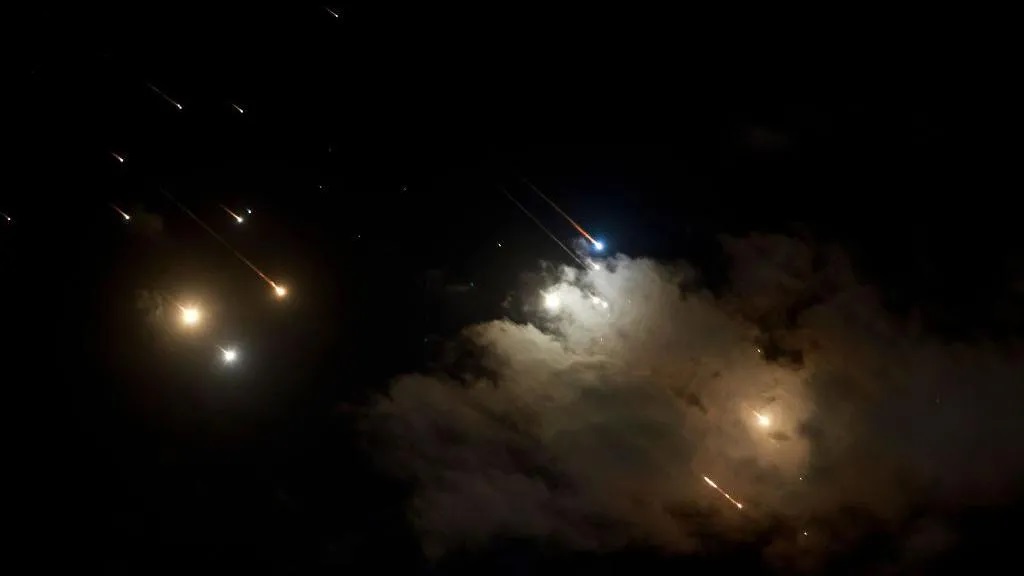





Iran’s military chief said the missile attack launched Tuesday was limited to military targets, but warned of broader strikes if Israel responds.
Major General Mohammad Bagheri said Iran had targeted military infrastructure including the Mossad intelligence agency, the Nevatim Air Base, Hatzor Air Base, radar installations and groupings of Israeli tanks, despite having the option of launching a much broader attack.
“We had the capability to attack the regime’s economic infrastructure, but we only targeted military bases,” he said Wednesday.
He added a warning to Israel and its supporters.
“If the Zionist regime is not controlled and takes action against Iran, we will target all of its infrastructure,” he said.
Bagheri said the strikes against Israel were in retaliation for the assassinations of Ismail Haniyeh, Hassan Nasrallah and Abbas Nilforoushan.
Nasrallah, who led the Iran-backed Lebanese militant group Hezbollah for more than 30 years, was killed in an Israeli airstrike on his underground headquarters in Beirut on Friday. Nilforoushan, a senior commander from Iran’s powerful Islamic Revolutionary Guard Corps, was killed alongside him, according to Iranian state media.
Hamas political leader Haniyeh was assassinated in Tehran in July using an explosive device that had been covertly hidden in the guesthouse where he was staying, a source familiar with the matter told CNN. The Iranian government and Hamas say Israel carried out the assassination. Israel has neither confirmed nor denied its involvement.
“Since the assassination of Martyr Haniyeh, we have gone through a difficult period of restraint at the repeated request of the Americans and Europeans, who asked us to hold back to establish a ceasefire in Gaza. However, after the martyrdom of Sayyed Hassan Nasrallah and Commander Nilforoushan, the situation became intolerable,” Bagheri said.
Israel weighs response to Iran attack as regional escalation fears grow.
Israel has vowed to respond to Iran’s largest ever attack on the country, fueling fears of a further escalation of conflict in the Middle East.
Iran launched dozens of missiles toward Israel on Tuesday in what Tehran said was a response to the killing of Hezbollah leader Hassan Nasrallah and others, just hours after Israel said it had launched a “limited and localized” ground operation against the Iran-backed group in Lebanon.
The Israel Defense Forces (IDF) said it estimated that Iran fired 180 “projectiles” at the country. It said it intercepted many of the missiles, although some landed on the ground in Israel and the occupied West Bank.
At least one person was killed and several were injured during the attack, according to the Israeli military. The extent of the damage remains unclear.
Here’s what you need to know.
Fears of all-out war: Iran’s attack has further raised the stakes in what is already an extremely tense moment. World leaders have long warned the conflict between Israel and Iran’s proxies Hamas in Gaza and Hezbollah in Lebanon could spiral into a wider regional war — and all eyes will now be on how Israel responds.
Israeli signals: Speaking after the assault, Prime Minister Benjamin Netanyahu said Iran made a “big mistake” and “will pay” for it. “The regime in Iran does not understand our determination to defend ourselves and our determination to retaliate against our enemies,” he said.
Major concern: One big fear for US and Arab diplomats is the possibility of Israel striking inside Iran, potentially against its nuclear facilities. Top officials from France, Britain, Germany and the European Union all condemned Iran’s attacks on Israel, warning of potentially disastrous consequences for the wider region.
What the US says: President Joe Biden praised the US’ role in thwarting Iran’s missiles, calling the attack “defeated and ineffective.” He said the United States was “fully supportive” of Israel but his administration was still discussing with Israel what kind of response would be appropriate.
Iran’s targets: Iran’s Islamic Revolutionary Guard Corps (IRGC) said it targeted three Israeli military bases around Tel Aviv. CNN analysis of geolocated videos of the attack shows a significant concentration of missiles fell either at, or near, the headquarters of intelligence service Mossad, Nevatim Air Base and Tel Nof Air Base. CNN has reached out to the IDF for comment.
Israeli attacks: Israel’s military said its operational capabilities had not been affected by Iran’s strikes. Hours later, the Israeli military said it struck Hezbollah targets in Lebanon’s capital Beirut. An IDF spokesperson said Israel would continue to pursue Hezbollah and anyone who threatened Israeli citizens. “Iran committed a serious act tonight, pushing the Middle East towards escalation. We will act at the time and place we decide,” he said.
Blasts heard in Beirut as Israeli military says it’s striking southern suburbs
CNN teams in Beirut heard blasts overnight Tuesday into Wednesday.
Thick plumes of smoke were visible in the sky above the capital’s southern suburbs, a CNN photo shows.
The Israel Defense Forces (IDF) earlier said it is striking Hezbollah targets in several southern suburbs of Beirut and more details of the operation would follow.
It also told residents to evacuate several neighborhoods and buildings in the southern suburbs, where it suggested strikes are planned.
In one of a few messages posted to X after midnight local time, IDF Arabic spokesperson Avichay Adraee warned that residents are located near “dangerous facilities belonging to Hezbollah against which the Defense Force will act with strength shortly.”
Evacuation orders from the Israeli military have been posted on social media between midnight local time and 3 a.m., likely when many people are sleeping.
An estimated 1 million people in Lebanon have been displaced over the past couple of weeks, thousands of them sheltering in Beirut, including in schools on the edges of the southern suburbs of the city.
Investigators comb crater for clues at scene of Iranian missile attack near Israeli school
Israeli authorities were picking through pieces of shrapnel to identify the type of missile used in the aftermath of an attack carried out by Iran on Tuesday.
CNN’s Jeremy Diamond, reporting from the site of an attack near a school in the central Israeli town of Gedera, said the impact of the strike left a wall and the windows of a second-grade classroom shattered, with significant damage seen inside.
Workers and heavy machinery could be seen in the background clearing through debris around a large crater measuring around 8 feet at its deepest portion. Shrapnel pieces could also be seen laid out as they were collected for further analysis.
No casualties were reported but hours before the attack, children had been attending the school.
Remnants of an Iranian ballistic missile, including the guidance section and the warhead, were visible in the images and videos taken by CNN at the site of the crater, according to Trevor Ball, a former senior explosive ordnance technician for the US Army.
He said it was difficult to identify the exact model due to the lack of reference images.
The areas targeted in Iran’s missile strike on Israel
Social media
Of the approximately 180 missiles the Israel Defense Forces say Iran fired Tuesday night, at least three apparent targets have emerged from a CNN analysis of geolocated videos of the attack.
It’s still too early to tell whether the attack resulted in any serious damage – that will require daylight and likely satellite imagery – but by analyzing the videos from the attack we have a picture of what Iran targeted.
Footage shows a significant concentration of missiles fell either at, or near, the headquarters of Mossad, Nevatim Air Base and Tel Nof Air Base.
Those locations largely tally with what the US intelligence community, and the Israelis, believed would be targeted. Israel assessed that Iran would likely attack three Israeli air bases and an intelligence base, according to a person briefed on the matter. And a US military official told CNN that potential Iranian targets included air bases and intelligence command centers.
Videos show at least two missiles falling near the Mossad HQ in Tel Aviv’s Glilot neighborhood, a densely populated area with a number of residential and commercial buildings.
In southern Israel’s Negev desert, videos show a significant number of Iranian rockets hitting the Nevatim base. The facility, one of Israel’s largest, was previously hit by Iran during its April 13 attack (the IDF said the damage was minimal.)
In the area of the Tel Nof base, more than 15 miles south of Tel Aviv, another video showed a number of impacts.
Jordan vows it “will not be a battleground for anyone” following Iranian missile attack on Israel
Al Mamlaka TV
Jordan has vowed it “will not be a battleground for anyone,” after an Iranian missile attack on Israel ramped up tensions across the Middle East and compounded fears of a wider conflict.
The Ministry of Interior said missile fragments had fallen in different parts of the country including the capital Amman.
“Jordan’s position has always been that it will not be a battleground for anyone, protecting Jordan and its people is our number one responsibility,” Mohammad al-Momani, Minister of Government Communication, told the state-funded al-Mamlaka TV channel on Wednesday.
Three people sustained minor injuries from falling missiles and debris, according to al-Momani. “There is material damage that is being assessed right now,” he added.
State media broadcasts showed damage in several locations including one live report from Balqa governorate northwest of Amman where a reporter said a 2-meter missile fragment had landed.
Shelter order: In a rare move, the Jordanian military asked people to stay in their homes and put all its forces in a state of readiness. It also said it was taking “precautionary measures to build and support front-line units on the border fronts to protect the homeland.”
Jordan’s Air Force intercepted Iranian missiles Tuesday, according to a Jordanian official.
The Kingdom was one of the Arab countries that intercepted Iranian drones and missiles that were part of a previous attack against Israel by Iran on April 13.
How Israel defends against aerial attacks
Israel operates a range of defensive systems to block attacks by everything from ballistic missiles with trajectories that take them above the atmosphere to low-flying cruise missiles and rockets.
The country’s Iron Dome system has been in the headlines often since regional hostilities ramped up last year in the wake of Hamas’ October 7 attack on Israel and the Israeli military’s subsequent bombardment of Gaza. But the Iron Dome is the bottom layer of Israel’s missile defense, according to the country’s Missile Defense Organization (IMDO).
There are at least 10 Iron Dome batteries in Israel, each equipped with a radar that detects rockets and then uses a command-and-control system that quickly calculates whether an incoming projectile poses a threat or is likely to hit an unpopulated area. If the rocket does pose a threat, the Iron Dome fires missiles from the ground to destroy it in the air.
The next rung up the missile defense ladder is David’s Sling, which protects against short- and medium-range threats, according to the IMDO.
David’s Sling, a joint project of Israel’s Rafael Advanced Defense System and US defense giant Raytheon, uses Stunner and SkyCeptor kinetic hit-to-kill interceptors to take out targets as far as 186 miles away, according to the Missile Threat project at the Center for International and Strategic Studies (CSIS).
Above David’s Sling are Israel’s Arrow 2 and Arrow 3 systems, jointly developed with the United States.
The Arrow 2 uses fragmentation warheads to destroy incoming ballistic missiles in their terminal phase – as they dive toward their targets – in the upper atmosphere, according to the CSIS. The Arrow 2 has a range of 56 miles and a maximum altitude of 32 miles, according to the Missile Defense Advocacy Alliance, which called the system an upgrade of the US Patriot missile defenses Israel once used in this role.
Meanwhile, the Arrow 3 uses hit-to-kill technology to intercept incoming ballistic missiles in space, before they reenter the atmosphere on their way to targets.
Israeli military striking Hezbollah targets in Beirut
Israel’s military is currently striking Hezbollah targets in Beirut, according to the Israel Defense Forces (IDF).
It said that details of the operation would follow.
Israeli military tells Beirut residents to evacuate southern suburbs neighborhoods and buildings
From CNN’s Jomana Karadsheh, Ben Wedeman and Sarah El Sirgany
The Israel Defense Forces (IDF) told residents to evacuate several neighborhoods and buildings in the southern suburbs of Beirut, where it suggested that strikes are planned.
In a message posted to X after midnight local time, IDF Arabic spokesperson Avichay Adraee warned that the residents are located near “dangerous facilities belonging to Hezballah against which the Defense Force will act with strength shortly.”
Iranian Shahab-3 series missiles likely used in attack on Israel, experts say
Variants of the Iranian Shahab-3 series ballistic missiles were used in the latest missile attack on Israel, weapons experts who analyzed verified social media videos from the scene told CNN.
Trevor Ball, a former senior explosive ordnance technician for the US Army, told CNN that fragments consistent with Shahab-3 variants such as Emad or Ghadr, were identifiable from images and videos of the attack. In one video, debris of a booster with visible markings of an Emad missile was visible, according to Ball. Different models such as the Kheibar Shekan or, less likely, a Fattah could also have been used, he added.
The Shahab-3 is the foundation for all Iran’s medium-range ballistic missiles using a liquid-propellant, according to Patrick Senft, a research coordinator at Armament Research Services (ARES). “It is most likely based on a North Korean missile which itself is probably based on the Soviet-designed Scud missiles. The Shahab-3 was the first Iranian ballistic missile that could reach Israel,” he added.
Remnants of an Iranian ballistic missile, including the guidance section and the warhead, were visible in images and videos collected by CNN at the site of a rocket attack at a Shalhavot Chabad School in Gedera, according to both Ball and Senft. It is difficult to identify the exact model due to the lack of reference images, Ball said.
“Overall, such medium-range ballistic missiles don’t leave behind a lot of diagnostic fragments if they function as intended,” Senft also added.
Regarding claims that Iran used its Fattah 1 hypersonic missile for the first time during its attack on Israel, weapons experts expressed skepticism.
“It’s one of their newest ballistic missiles, and they have a lot to lose from using it,” Ball said. “Israel would get an idea of its capabilities just from being used. There’s also the chance it could fail to function, giving Israel an even greater idea of its capabilities. They get free propaganda and risk nothing by saying it was used.”
Israeli Air Force’s capability not affected by attack, will continue to strike in Middle East overnight: IDF
The Israeli Air Force will carry out more strikes in the Middle East overnight and its operational capabilities have not been affected by Iran’s missile strikes, according to the Israel Defense Forces (IDF).
“The Air Force continues to operate fully, and tonight it will continue to strike in the Middle East powerfully, as has been happening throughout the past year,” IDF spokesperson Daniel Hagari said late on Tuesday night local time.
The statement came after new video footage emerged showing Iranian missiles striking Nevatim air base in southern Israel.
Hagari added that Israel would continue to pursue Hezbollah commanders and anyone who threatened Israeli citizens.
“Iran committed a serious act tonight, pushing the Middle East towards escalation. We will act at the time and place we decide,” Hagari said.
US officials recently thought the prospect of an Iranian missile attack against Israel had been thwarted
Even until a few weeks ago, some senior US officials privately believed that through its diplomatic and deterrence efforts, the US had helped to successfully thwart a large-scale Iranian attack against Israel, sources told CNN.
But Iran’s missile attacks against Israel on Tuesday marked yet another development in the Middle East that the Biden administration had hoped to avoid, but could not. Israel’s strikes in the Lebanese capital of Beirut last month that killed Hezbollah leader Hassan Nasrallah, in particular, appears to have effectively guaranteed that Iran would move ahead with its offensive against Israel.
And even before Israel assassinated Nasrallah, there were some indications that Iran had grown alarmed about the degree of damage that Israel was inflicting on its most powerful and capable proxy militia in the region, according to a US military official.
The US believed that Iran would intervene in the conflict if it judged that it was about to “lose” Hezbollah, according to a senior US official. The combined effects of Israel’s operations against Hezbollah had already taken hundreds of fighters off the battlefield, according to that official and another person familiar with the intelligence.
“I think Nasrallah was the final straw” for Iran, said Jonathan Panikoff, a former senior intelligence analyst specializing in the region. “Strategically, it’s a combination of recognizing Hezbollah could really be in trouble and needing to restore some deterrence.”
Hezbollah itself also remains a dangerous adversary for Israel. Even if Israel has done severe damage to Hezbollah’s command structure, the group still maintains a dangerous arsenal of military assets it could bring to bear against Israel.
In a series of back-and-forth strikes across the border — including a particularly intense exchange on August 25 — Hezbollah has so far held back from using some of their more sophisticated long-range fire options, like ballistic and cruise missiles, potentially preserving them for later use, according to current and former US officials. And even though Israel has struck many of its launch sites, those officials say, others still remain.
US officials have long assessed that both Iran and senior Hezbollah leadership has wanted to avoid all-out war with Israel, even as both have exchanged fire in recent months. In April, Iran fired more than 300 missiles and drones at Israel.
Iran uses domestically produced hypersonic missile for the first time, local media reports
Iran used its Fattah 1 hypersonic missile for the first time during its attack on Israel on Tuesday, according to the semi-official Iranian media outlet Mehr News.
The Fattah is considered Iran’s first domestically produced hypersonic missile.
Iran’s military unveiled the weapon last year, saying it can travel up to 15 times the speed of sound and is capable of “targeting missile defense systems.”
What we know about the Biden administration’s response to Iran’s missile attacks
Tuesday’s attack in Israel was a “significant escalation” by Iran with more than 200 ballistic missiles shot toward the country, the White House said Tuesday. US Navy destroyers fired roughly a dozen interceptors against the Iranian missiles
Iran’s attack against Israel today was twice as large as Iran’s attack in April, Pentagon spokesperson Maj. Gen. Pat Ryder said Tuesday.
Here’s what we know about the Biden administration’s response to the attacks:
White House comments on attack’s impact:
National Security Adviser Jake Sullivan said at a press briefing Tuesday that Iran’s attack “appears to have been defeated and ineffective.” Sullivan said the US and the IDF were still trying to assess the impact of the attack and stressed that it was still early in that assessment. He called the matter “a fluid situation.”
While the US has been warning citizens in the region for some time about the possibility of escalating attacks, Sullivan said there was the US had “not begun triggering a noncombatant emergency evacuation… and do not have an intention to do so at this time.”
Administration braced for Iran’s retaliation for weeks:
In recent weeks, as Israel carried out targeted attacks on top Hezbollah and Hamas leaders and the outlook for negotiations over ceasefire proposals in Gaza and Lebanon grew dim, the Biden administration has been bracing for potential retaliation by Iran or its proxies.
Following the assassination of Hamas political leader Ismail Haniyeh carried out by Israel in Tehran, the Pentagon in early August said it was moving military vessels and aircraft across the region to bolster the US’s defense capabilities. A week later, the White House echoed Israeli intelligence that showed an Iranian attack could be imminent – a warning voiced before Israel’s top spy agency carried out a complex operation detonating thousands of pagers and walkie talkies carried by some Hezbollah operatives and a targeted strike in densely-populated Beirut that killed Hezbollah leader Hasan Nasrallah.
Inside the Situation Room meeting:
US President Joe Biden and Vice President Kamala Harris convened a meeting Tuesday in the White House’s Situation Room, where they met with top national security officials.
According to the White House, the two “reviewed the status of U.S. preparations to help Israel defend against these attacks and protect U.S. personnel in the region.”
Harris also condemns attack:
Harris condemned Iran’s attack and said she supports Biden’s decision to direct US military to help Israel shoot down Iranian missiles.
“Iran is a destabilizing, dangerous force in the Middle East, and today’s attack on Israel only further demonstrates that fact,” Harris said during remarks at Josephine Butler Parks Center in Washington, DC.
Iranian missile appears to hit less than a kilometer from Mossad headquarters in videos
CNN geolocated the video and found it was filmed from a high-rise apartment building in Herzliya, less than 3 kilometers (1.8 miles) from the headquarters of the Israeli intelligence service.
CNN geolocated another video appearing to show the impact of this missile in a nearby parking lot. The video shows a large crater, with dirt from the impact covering nearby vehicles. The crater is just a few hundred meters away from a cinema complex.
CNN cannot independently confirm the intended target of the missile, or that the crater was caused by the impact seen in the video shot from the apartment. However, it is likely that this was the cause, based on the missile’s trajectory.
55 people killed in Israeli strikes on Lebanon, Lebanese health ministry says
Fifty-five people were killed and 156 were injured in Israeli airstrikes on Lebanon in the past 24 hours, according to the Lebanese health ministry.
Among the victims, 22 were killed and 47 were injured in the city of Nabatieh, the ministry said.
Analysis: The world holds its breath as Israel ponders its response to Iran’s attack
Tuesday’s attack by Iran on Israel could shift the scales in the already extremely tense situation in the Middle East as Israeli Prime Minister Benjamin Netanyahu vowed Tehran “will pay.”
Up until now, Iran has mostly used its proxies in the region — Hamas in Gaza, Hezbollah in Lebanon and the Houthis in Yemen — to strike against Israel.
When it attacked Israel directly in April, after accusing it of bombing its diplomatic complex in Syria, the assault appeared designed for effect rather than impact.
Tuesday’s missile strikes seemed different.
The Pentagon said Iran’s attack on Tuesday was twice as large as Iran’s last barrage against Israel in April. Tehran said the barrage was a response to the killing of Hezbollah leader Hassan Nasrallah and others. It came just hours after Israel announced it launched “limited and localized” ground operation against Hezbollah in Lebanon — something that would have been seen by Iran as a major escalation.
While the Israel Defense Forces (IDF) said most of the missiles were intercepted, some have landed on Israeli soil and appear to have caused damage.
Unlike in the spring, when Israel had days to prepare for the attacks, it received little warning on Tuesday, learning about the imminent threat just hours before Tehran launched the barrage.
Whatever Israel decides to do in response could shape the next stage of the conflict. It opted for a limited response back in April following pleas by the US and other allies to exercise restraint. But the words used by Israeli officials on Tuesday suggests the reaction might be more forceful this time.
IDF spokesperson Rear Admiral Daniel Hagari called the barrage a “serious attack” and said “there will be serious consequences.” Hagari did not elaborate on what these consequences might be.
The worry among the international community is that Israel might decide to target some of Iran’s nuclear facilities. That is something Israel didn’t do in April — possibly because it worried about how Hezbollah would react to such a forceful move. Instead, it chose to strike military defenses near these facilities. With Hezbollah greatly weakened after the recent spate of Israeli attacks targeting its top officials, that risk could now play much smaller part in Israel’s calculation.
France, UK, Germany and EU condemn Iranian attack on Israel
Top officials from France, Britain, Germany and the European Union have all condemned Iran’s missile attacks on Israel, warning of potentially disastrous consequences for the wider region.
British Prime Minister Keir Starmer denounced what he called an “attempt by the Iranian regime to harm innocent Israelis” and “escalate this dangerous situation” in the Middle East.
The British leader was on a phone call to his Israeli counterpart, Benjamin Netanyahu, when the Iranian attack began, according to a readout from Starmer’s office.
“I am deeply concerned that the region is on the brink, and I am deeply concerned about the risk of miscalculation.”
Starmer said during a video statement.
Starmer said he had used calls with Netanyahu and his Lebanese, French and Palestinian counterparts to push for a “political route forward.”
Annalena Baerbock, Germany’s foreign minister, also condemned Iran’s attack “in the strongest possible terms.”
“We have urgently warned Iran against this dangerous escalation. Iran must stop the attack immediately. It is leading the region further into the abyss,” Baerbock said on X.
French Prime Minister Michel Barnier also weighed in on what he described as “an extremely serious situation in the Middle East.”
“I am speaking … at a time when the situation is worsening in the Near and Middle East, with an escalation and an attack, and a direct conflict that seems to be underway between Iran and Israel,” Barner told lawmakers in the French parliament.
Josep Borrell, the EU’s top diplomat, warned a “dangerous cycle of attacks and retaliation” is underway that risks “spiraling out of control.”
The bloc is “fully committed to contribute to avert a regional war,” Borrell said, stressing that “an immediate ceasefire across the region is needed.”
Israeli air base hit by Iranian attack, new videos show
Two new videos show a number of Iranian missiles striking Nevatim air base in southern Israel based on geolocation analysis by CNN.
Iran previously targeted the same base during a similar April 13 attack.
How CNN geolocation worked: The videos were filmed from Ar’arat an-Naqab, a town just south of the air base, in southern Israel’s remote Negev desert. CNN was able to geolocate the videos by matching the buildings seen in the videos to archival photos of the town and the airbase.
What’s seen in the videos: As the camera pans skyward, dozens of rocket trails can be seen falling toward the base. Sirens are heard wailing in the background.
Then, in both videos, a single interceptor missile can be seen rising from a battery near the base before it travels out of frame.
The control tower at the air base can be seen in one of the videos as the missiles begin to impact and explode. Smoke begins to rise across the area of the base, as the sound of more impacts is heard, and more explosions are seen.
Without daylight, however, it’s unclear what exactly was hit at the base.
CNN has reached out to the Israel Defense Forces for comment on the videos, but did not immediately receive a response.
After the April 13 attack, Daniel Hagari, Israeli military spokesperson, confirmed that some of the hundreds of projectiles fired at Israel did hit the base, causing minor damage to the infrastructure there, including in an area near the runway.
Nevatim remained fully functional then, Hagari said at the time.
1 Palestinian killed in West Bank during missile attacks, IDF says
At least one person was killed and several injured as Iran launched a missile attacks and Israel launched interceptors Tuesday, according to the Israel Defense Forces (IDF),
One Palestinian was killed in Jericho as a result of the attacks, the IDF’s international spokesperson Nadav Shoshani told CNN’s Jake Tapper.
The hospital in Jericho, a city in the occupied West Bank, that treated the man said he had died from injuries caused by shrapnel from an interceptor missile launched by Israel to counter the attack.
Shoshani said Iran’s firing of nearly 200 missiles toward Israel was an attempt to “harm and kill civilians” and risked “dragging the region into a wider escalation.”
Asked if Israel would retaliate, he said, “we will choose the time and place and the way we will respond to this outrageous attack against Israeli citizens.”
Two people were lightly injured from shrapnel in Tel Aviv, Israel’s Magen David Adom emergency services said.
Netanyahu says Iran “made a big mistake” and “will pay”
Israeli Prime Minister Benjamin Netanyahu told Israelis that Iran “made a big mistake” and “will pay” for launching a missile attack on the country Tuesday.
“Tonight, Iran again attacked Israel with hundreds of missiles. This attack failed. It was thwarted thanks to Israel’s air defense system, which is the most advanced in the world,” Netanyahu said from a meeting with his political security cabinet, in a video released by the Israeli government’s press office. “I congratulate the IDF for its impressive achievement.”
“It was also thwarted thanks to the vigilance and responsibility shown by you – the citizens of Israel. I also thank the United States for its support in our defense effort,” Netanyahu added.
“Iran made a big mistake tonight – and it will pay for it. The regime in Iran does not understand our determination to defend ourselves and our determination to retaliate against our enemies,” he said.
“We will stand by the rule we established: whoever attacks us — we will attack him,” he continued.
Netanyahu also addressed the attack in Tel Aviv’s neighborhood of Jaffa, sending condolences to the families of those killed. “As with the missile attack, there is also a deliberate and murderous hand behind this attack – it comes from Tehran,” he said.
7 killed in Tel Aviv attack, emergency services say
The death toll from the Tel Aviv shooting and stabbing attack has risen to seven, after one of the wounded died from the injuries he sustained, the Tel Aviv Ichilov Medical Center said.
It was initially reported that six people were killed and 12 wounded, according to Israel’s Magen David Adom (MDA) emergency services said.
MDA medics said they treated victims at several sites on Jerusalem Boulevard, including near train tracks, in the street, at a synagogue and in a butcher’s shop.
The injured were taken to hospitals while air-raid alarms sounded in the region and throughout Israel.
This post has been updated to reflect a higher death toll.
Israel’s UN ambassador calls for emergency session and says response to Iran “will be painful”
Danny Danon, Israel’s ambassador to the United Nations, is calling for an emergency session of the UN Security Council to “convene as soon as possible” after Iran attacked Israel with nearly 200 missiles.
He told reporters at the UN Tuesday that Israel has a right to defend itself.
“We will act. Iran will soon feel the consequences of their actions. The response will be painful,” Danon said.
He added that “10 million people were forced into bomb shelters” as Iran attacked. “Imagine the entire population of New York City in 10 minutes has to seek shelter. Children, babies, elderly — that’ s what happened in Israel.”
Danon called Iran a “terrorist state” that had shown “its true face” to the world.
Iran warns aircraft that a “near conflict zone” exists in its western and southern airspace
Iranian officials have warned aircraft that a “near conflict zone” exists in its western and southern airspace, specifically near Iraq, Kuwait and Turkey.
The notice, sent to airmen by Iran’s aviation authority Tuesday evening, urges all operators to “take military activity risk” into consideration.
The warning could hit air travel across Europe and Asia, given that a number of airlines — many of them headquartered in Persian Gulf countries — travel through that airspace to fly to the Middle East and Europe.
Iraq and Jordan both temporarily closed their airspace around the time the Iranian attack began on Tuesday evening.
The US will coordinate with Israel on response to Iran missile attack
State Department spokesperson Matthew Miller would not say whether Iran’s nuclear program is a legitimate target for Israeli retaliation after the Iranian missile attack, saying, again, the US plans to “discuss those consequences with our Israeli counterparts before we talk about them publicly.
“This is not to say I’m ruling anything out and that I’m ruling anything in, but I would answer any question this way, which is, we want to have these conversations directly with our Israeli counterparts over the coming days,” he said in response to a question from CNN.
Miller echoed National Security Advisor Jake Sullivan in stating the US will coordinate with Israel on its response to the attack on Israel, calling it “a significant escalation.” He also pledged that there would be consequences.
“Of course there must be consequences for Iran for this attack. We’ve made clear that there must be consequences. I’m not going to get into what those consequences are today, but they are things on which we will be coordinating with our Israeli counterparts,” Miller said at a press briefing Tuesday.
He said the missile attack was defeated in part due to coordination between the US, Israel and partners. Miller did not specify which other countries.
Asked if Israel has done anything escalatory in the past weeks, Miller argued Israel “certainly” has “done things to expand the conflict, but if you look at the actions they have taken, they were bringing terrorists to justice.”
Israel last week assassinated Hezbollah leader Hassan Nasrallah in a major strike on Beirut.
By contrast, he said that today “Iran came to the defense of a terrorist organization.”
“If you look at what Iran did today — we have been warning for some time about the threat posed by Iran arming and funding terrorist groups across the Middle East, and the attack today just demonstrated the danger of those actions,” Miller said.
“What you saw was Iran launching a state on state attack to protect and defend the terrorist groups that it has built, nurtured and that it controls. So there is a difference,” Miller said Tuesday.
Miller also said “this wave of the attack is over,” adding that he does not mean other waves are coming. The US view is that it would be “incredibly escalatory” if Iran were to carry out further strikes in Israel.
Pentagon says Iran’s Tuesday attack against Israel was twice as large as its April attack
Iran’s attack against Israel today was twice as large as Iran’s attack in April, Pentagon spokesperson Maj. Gen. Pat Ryder said Tuesday.
“[I]t’s about twice as large in terms of the number of ballistic missiles that they launched from the last,” he said, adding that you “don’t launch that many missiles at a target without the intent of hitting something.”
“So absolutely, just like the last time their intent is to cause destruction,” he said.
Iranian president says Tuesday missile strike was “only a portion of our power”
Iran’s President Masoud Pezeshkian said its missile strike on Israel was in defense of Iran’s interests and citizens, warning on X that the operation on Tuesday was “only a portion of our power.”
“This action was in defense of the interests and citizens of Iran. To let (Israeli Prime Minister Benjamin) Netanyahu know that Iran is not belligerent, but it stands firmly against any threat,” he wrote. “Do not enter into a conflict with Iran.”
In a message posted on X, Iranian Supreme Leader Ayatollah Ali Khamenei warned in Hebrew that the “blows” against Israel would become “stronger and more painful.”
“With God’s help, the blows of the uprising front will become stronger and more painful on the worn and rotting body of the Zionist regime,” he said.
The barrage comes after Israel launched a ground operation across its northern border into Lebanon targeting the Iran-backed militant group Hezbollah. Israel killed Hezbollah’s leader Hassan Nasrallah in an airstrike last Friday and decimated the leadership of the most powerful paramilitary force in the Middle East — ratcheting up fears of a new regional war.
About 6,000 Americans have asked for more information about possibly leaving Lebanon, State Department says
About 6,000 Americans have reached out to the US State Department for further information about potentially departing Lebanon, spokesperson Matthew Miller said Tuesday.
Not all of those who have registered on the form are actively seeking assistance to leave the country that is under increasing Israeli assault.
The US is “working with airlines to provide additional flights with more seats for American citizens, and it’s something that we hope to turn on in the next few days,” Miller said.
“As we often do in these situations, we have directed US citizens who are in Lebanon to register with the State Department for information, and especially for information with how to depart Lebanon, and we’re providing them whatever information we can,” Miller said at a State Department briefing.
“People are just looking for information. They’re looking for options. There are a number of American citizens who live in Lebanon who have lived there for years and may not want to depart the country,” he added.
Miller said Monday that the US is “not evacuating American citizens from Lebanon at this time.”
“We always conduct a prudent planning process. We have been doing that for some months, going all the way back to October 7. But at this time, there’s still commercial options available,” he said.
He reiterated on Tuesday that Beirut’s airport is still open as he outlined efforts to get more seats for Americans.
Iran’s IRGC says it targeted 3 Israeli military bases in missile attack
Iran’s Islamic Revolutionary Guard Corps (IRGC) said it targeted three Israeli military bases around Tel Aviv during a wave of missile launches Tuesday, according to the semi-official Iranian media outlet Mehr News.
The Israeli military has initially estimated that Iran fired about 180 missiles.
Iran’s attack “totally unacceptable,” US secretary of state says
US Secretary of State Antony Blinken called the Iranian missile attack against Israel “totally unacceptable” and added that the “entire world should condemn it.”
Blinken said this attack included “some 200 ballistic missiles.” Israel initially estimated that 180 missiles were launched at the country.
Israel “effectively defeated this attack,” Blinken added.
Blinken was speaking at the State Department ahead of a meeting with the Indian external affairs minister.
US Navy destroyers fired a dozen interceptors against Iranian missiles, Pentagon says
US Navy destroyers fired roughly a dozen interceptors against Iranian missiles that were launched toward Israel on Tuesday, Pentagon spokesperson Maj. Gen. Pat Ryder said Tuesday.
The US currently has three guided-missile destroyers operating in the eastern Mediterranean: USS Arleigh Burke, USS Cole and USS Bulkeley. According to Ryder, the destroyers involved were the USS Bulkeley and USS Cole.
Ryder also said US Defense Secretary Lloyd Austin spoke a second time on Tuesday with Israeli Minister of Defense Yoav Gallant, after speaking with him before Iran’s attack.
“He reaffirmed the United States’ ironclad commitment to the defense of Israel and underscored that the US remains well postured throughout the Middle East region to protect US forces and defend Israel in the fact of threats from Iran and Iran-backed terrorist organizations,” Ryder said.
US destroyers also took part in intercepting Iran’s barrage of ballistic missiles and drones on April 13, shooting down several of the missiles launched at Israel.
This post has been updated with additional details from the Pentagon’s spokesperson.
Hamas praises Iranian missile attacks on Israel
Hamas praised the launch of Iranian missiles toward Israel on Tuesday, saying they avenged the deaths of Hezbollah leader Hassan Nasrallah, Hamas political leader Ismail Haniyeh and Abbas Nilforoushan, a senior commander in Iran’s powerful Islamic Revolutionary Guard Corps (IRGC).
Those three figures have been killed by Israeli airstrikes in recent weeks and days, tipping the region closer toward a multi-front conflict.
“We affirm that this honorable Iranian response is a strong message to the Zionist enemy and its fascist government, on the path to deterring them and curbing their terrorism, as their crimes, arrogance, and violations of international laws and humanitarian norms have exceeded all limits,” Hamas said in a statement.
Some context: Israel has been engaged in a war against the militant group in Gaza since Hamas’ attacks on October 7 last year.
Iran-backed Hezbollah has meanwhile exchanged tit-for-tat attacks on Israel’s northern border since the same date, in solidarity with Hamas, and those confrontations have escalated in recent weeks.
Israeli official vows “significant response,” as citizens told to leave shelters after Iranian attack
Israel will carry out a “significant response” to Iran’s attack, an Israeli official told CNN Tuesday.
“What Iran has suffered so far is only a promo,” the official said.
Those warnings echoed the message from Israel Defense Forces spokesperson Rear Adm. Daniel Hagari, who said in a televised message on Tuesday that “this attack will have consequences.”
“We have plans, and we will operate at the place and time we decide,” Hagari said.
The barrage of missiles fired at Israel on Tuesday evening caused citizens to rush to cover, but the Israeli military has said that no new attacks have been identified and it is safe for people to leave their shelters.
Jordanian military puts troops on high alert following Iran’s missile attack on Israel
Jordan’s military said in a statement that all units and formations in its armed forces’ general command have been put on “on high alert to confront any attempts that threaten the security and stability of the kingdom.”
Citing a military source in the armed forces general command, the statement added:
“The General Command is closely monitoring the developments occurring in the region and has taken necessary precautionary measures to build and support front-line units on the border fronts to protect the homeland.”
Here’s what we know about Iran’s attack on Israel, so far
Iran launched a missile attack on Israel on Tuesday in response to the killing of Hezbollah leader Hassan Nasrallah and others, according to a statement by the Islamic Revolutionary Guard Corps.
Earlier on Tuesday, the US said it believed that a ballistic missile attack on Israel was imminent after Israel launched a ground operation in southern Lebanon.
Here’s what we know about the attack so far:
Over 100 missiles launched: The Israeli military estimated that Iran fired 180 “projectiles,” but stressed that it was not the final count. CNN teams saw dozens of missiles over the cities of Tel Aviv, Jerusalem and Haifa. CNN’s Jim Sciutto said he saw multiple missiles intercepted. Meanwhile, Jordan’s military said in a statement that “hundreds of Iranian missiles were launched toward Israel,” citing a military source in its armed forces general command. Some Iranian missiles made direct impact in central and southern Israel, an Israeli military spokesperson said.
No injuries reported as people bunkered: Sirens blared in Israel as people were told to bunker as the missiles came down, including the Israeli security cabinet, according to an Israeli source. There were no injuries following Iran’s attack, Israel Defense Forces spokesperson Rear Adm. Daniel Hagari said.
Warnings of escalation: The Iranian Mission to the United Nations said Tuesday afternoon that Tehran’s response has “been duly carried out” and if Israel should “dare to respond or commit further acts of malevolence, a subsequent and crushing response will ensue.” An Israeli military spokesperson said “there will be serious consequences.”
US support: A US defense official said that US forces in the Middle East were “defending against Iranian-launched missiles targeting Israel.” Meanwhile, US President Joe Biden and Vice President Kamala Harris were in the Situation Room at the White House monitoring the attack. The president “directed the US military to aid Israel’s defense against Iranian attacks & shoot down missiles targeting Israel,” a National Security Council spokesperson said. House Speaker Mike Johnson and Senate Majority Leader Chuck Schumer have also been briefed on the attack, according to their respective spokespeople.
Israel hasn’t identified new aerial threats from Iran, IDF says
Israel Defense Forces spokesperson Rear Adm. Daniel Hagari said Israel has not identified any additional aerial threats from Iran at this stage.
“You may leave the protected spaces, and should continue to follow the Home Front Command’s guidelines. I ask you to continue demonstrating responsibility and to be alert,” Hagari told Israeli people in a televised statement on Tuesday.
Iran fired 180 missiles at Israel, according to initial Israeli military estimate
The Israeli military’s initial estimate is that Iran fired 180 “projectiles” at Israel.
“At this moment, we understand it was approximately 180 projectiles,” an Israel Defense Forces spokesperson told CNN. “But this is not final, and (is) an initial estimate.”
Israeli military says Iran’s attack “will have consequences”
Israel has plans to retaliate in response to Iran’s missile attack, the Israel Defense Forces spokesperson said Tuesday.
“This attack will have consequences,” Rear Adm. Daniel Hagari said in a statement. “We have plans, and we will operate at the place and time we decide.”
Some Iranian missiles made direct impact in central and southern Israel, the military says
Some Iranian missiles fired at Israel Tuesday night made direct impact in central and southern Israel, the Israeli military spokesperson said.
“We carried out many interceptions,” Rear Adm. Daniel Hagari said in a statement. “There are a few impacts in the center and some more in the south. At this stage, we are assessing the situation. We are not aware of injuries.”
No one was injured in Iran attack, Israeli military says as it warns of “serious consequences”
There were no injuries following Iran’s attack on Israel on Tuesday, Israel Defense Forces spokesperson Rear Adm. Daniel Hagari has said.
“There was a serious attack on us, and there will be serious consequences,” Hagari said Tuesday.
He added this was not the first time Israel had faced a threat from Iran.
“We are ready for them,” he said.
Celebratory gunfire and cheers heard in Beirut and Gaza
CNN’s team in the Lebanese capital of Beirut heard celebratory gunfire and fireworks on Tuesday evening as word spread of Iran’s huge missile attack on Israel.
Meanwhile, over on Israel’s other front, videos filmed by a CNN stringer in Gaza captured audible cheering as Iranian rockets flew overhead en route to Israel.
Hundreds of Iranian missiles launched toward Israel, Jordanian military says
Jordan’s military said in a statement that “hundreds of Iranian missiles were launched toward Israel,” citing a military source in its armed forces general command.
The country’s armed forces has called on citizens to remain at home “for their safety and the safety of their families,” the statement added.
Jordan’s Air Force has been active in intercepting Iranian missiles tonight, according to an official from the country.
CNN’s Alex Marquardt contributed reporting.
US forces defending against Iranian missile barrage, official says
From Natasha Bertrand, Oren Liebermann and Haley Britzky
A US defense official says that US forces in the Middle East “are currently defending against Iranian-launched missiles targeting Israel.”
The US has positioned an array of assets in the region that are capable of intercepting missiles, including destroyers in the eastern Mediterranean, a carrier strike group in the Arabian Sea, and fighter jet squadrons. It is not yet clear which assets engaged the missiles or how many were intercepted by the US.
Officials in northern Israel warn of falling fragments from intercepted projectiles
Israeli officials are urging residents in the northern municipality of Safed to remain in protected areas until further notice, warning of the potential of falling fragments from intercepted projectiles.
6 killed in Tel Aviv shooting and stabbing attack, according to Israeli police
Six civilians were killed and nine were wounded in a shooting and stabbing attack in Tel Aviv on Tuesday, Israeli police said, revising the previous death toll of eight.
Two attackers were “neutralized” by authorities and civilians at the scene using personal pistols, police added. Police earlier described the attackers as apparent “terrorists.”
Israel’s national emergency service says it happened near a light rail station in Jaffa.
This post has been updated with the revised death toll and details from Israeli police.
Credit: CNN