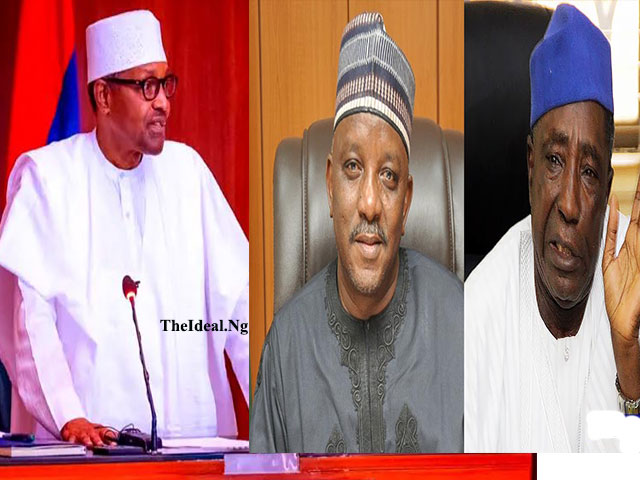





*President exercises power for first time in 6 years
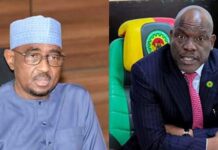
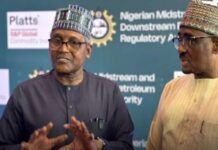
In what can be regarded as waking up from a deep slumber, President Muhammadu Buhari, on Wednesday, reshuffled his cabinet for the first time in his six years and sacked two ministers- Mohammed Nanono (Minister of Agriculture and Rural Development) and Sale Mamman (Minister of Power).
Theideal recalls that in his first four years in office between 2015 and 2019, Buhari retained all his cabinet members till the end of his tenure, an action that was unprecedented.
Nigerians have been very critical of some of the ministers, accusing them of non- performance while Buhari retained them in spite of public condemnation.
But with barely two years to the end of his second term in office and with many people believing that members of the cabinet would also remain till 2023, Buhari on Wednesday, surprised many Nigerians by sacking the two ministers
Announcing the removal of the two ministers in a statement by his Special Adviser on Media & Publicity, Mr Femi Adesina, during the Federal Executive Council (FEC) meeting on Wednesday, Buhari stated that Nanono and Mamman were leaving the cabinet.
In the same vein, Dr. Mohammad Abubakar, Minister of Environment, was redeployed to assume office as the Minister of Agriculture & Rural Development, while Engr. Abubakar Aliyu, Minister of State, Works & Housing will now be the Minister of Power.
The President further disclosed that the changes were sequel to the “tradition of subjecting our projects and programs implementation to independent and critical self-review” through sector reporting during Cabinet meetings and at retreats.
He added that “these significant review steps have helped to identify and strengthen weak areas, close gaps, build cohesion and synergy in governance, manage the economy and improve the delivery of public good to Nigerians.”
The full text of the statement is reproduced below for the records:
“On Wednesday 21st August, 2019 the current Federal Executive Council was sworn-in after a rigorous retreat to bring returning and new members up to speed on the accomplishments, challenges and lessons drawn from my first term in Office and to emphasise the 9 priority areas of government for the second term.
- Two years and some months into the second term, the tradition of subjecting our projects and programs implementation to independent and critical self-review has taken firm roots through sector Reporting during Cabinet meetings and at Retreats.
- These significant review steps have helped to identify and strengthen weak areas, close gaps, build cohesion and synergy in governance, manage the economy and improve the delivery of public good to Nigerians.
- I must commend this cabinet for demonstrating unparalleled resilience that helped the government to navigate the disruption to global systems and governance occasioned by the emergence of COVID-19 shortly after inauguration. The weekly Federal Executive Council meetings was not spared because the traditional mode was altered.
- As we are all aware, change is the only factor that is constant in every human endeavour and as this administration approaches its critical phase in the second term, I have found it essential to reinvigorate this cabinet in a manner that will deepen its capacity to consolidate legacy achievements.
- Accordingly, a few cabinet changes, marking the beginning of a continuous process, have been approved. They are as follows:
Ministers Leaving the Cabinet:
- Mohammed Sabo Nanono, Minister of Agriculture and Rural Development, and
- Engr. Sale Mamman, Minister of Power.
Redeployment:
- Dr. Mohammad Mahmood Abubakar, Minister of Environment, to assume office as the Minister of Agriculture & Rural Development;
- Engr. Abubakar D. Aliyu, Minister of State, Works & Housing assume office as the Minister of Power.
- In due course, substantive nominations will be made to fill the consequential vacancies in accordance with the requirements of the constitution.
- I have personally met with the departing members to thank them for their contributions to discussions in cabinet and the invaluable services rendered to the nation. Today, effectively marks their last participation in the Federal Executive Council deliberations and I wish them the best in all future endeavours.
- Finally, I wish to reiterate once more, that this process shall be continuous.
- I thank you all and May God bless the Federal Republic of Nigeria.”
TheIdeal recalls that Buhari has a tradition for sticking to his ministers and refuses to sack or rejig them until the end of his tenure.
Incidentally, Buhari is the first elected Nigerian President since 1999 not to have reshuffled his ministers in a four-year tenure.
When he won his re-election in 2019, Buhari gave reasons for his decision to retain the ministers despite pressures from some certain quarters to sack some of them.
He said, “Although we all had a common vision, we frequently had heated debates in this room on the best way to achieve our goals. These differing views are what made the decisions we took all the more rational.
“It is this quality that made me retain my cabinet for the full term. Each of you in this room has a unique skill and strength.
“We are a reflection of the Nigeria we aspire to achieve – A diverse but tolerant nation where no one is silenced and where every opinion should be heard and considered.”