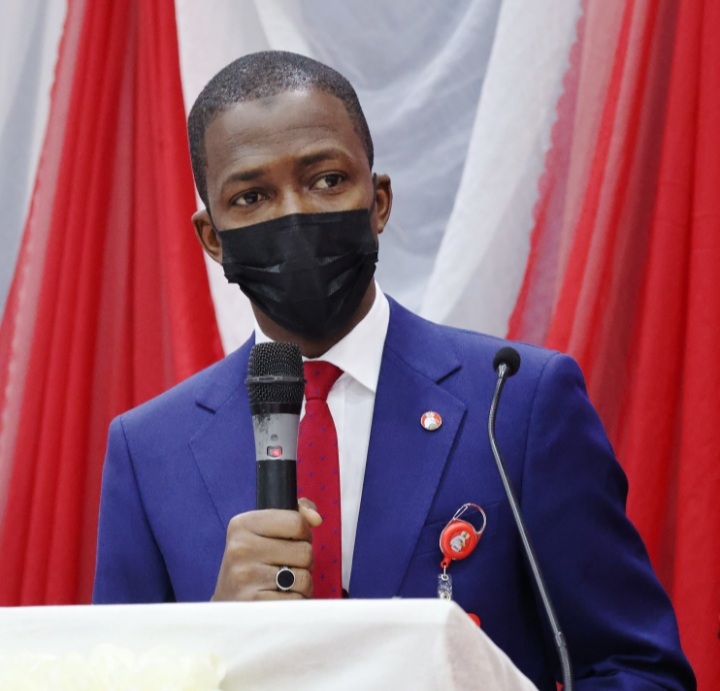





The Executive Chairman of the Economic and Financial Crimes Commission (EFCC), Mr Abdurasheed Bawa, has made a case for retention of the Special Control Unit Against Money Laundering (SCUML) under the EFCC.
Bawa stated this on Thursday during a public hearing organized by the Joint Committee of the Senate on Anti- corruption and Financial Crimes, Judiciary, Human Rights and Legal Matters; Ethics Privileges and Public Petitions at the National Assembly Complex, Abuja.
Speaking through the Secretary to the Commission, Mr George Ekpungu, Bawa further disclosed that the EFCC has painstakingly reviewed the two Money Laundering Bills to identify which best suit the context and interest of the country.
On why the SCUML should be retained in the EFCC, Bawa said, “It is therefore with the highest sense of responsibility that we request the passage of SB789. Our reason being that SCUML and to retain it under the EFCC, promotes efficiency in the conduct of government business as it will leverage on the existing structures and personnel.”
The EFCC boss also urged the Senate to prioritize institutional strengthening by enacting relevant legislations and amending existing ones to widen the scope of related duties.
He said, “We therefore wish to encourage the Senate to continue prioritizing institutional strengthening by enacting relevant legislations and amending existing ones to widen the scope of related duties similar to what is obtainable in the American Parliament in relation to FBI.
“The Commission has also remained committed in anchoring and enhancing the prevention mandate through the activities of SCUML more than in any other action.
“We have therefore gone through the bills and have forwarded our comments and observations on relevant sections notwithstanding, we recommend the passage of SB789, 644 and 645.”
In his remarks at the event, the Chairman of the Senate Committee on Anti-Corruption, Senator Sulaiman Abdu Kwari, stated that the main objective of the public hearing is to listen to stakeholders on the legislations with respect to the fight against corruption and other crimes.
He said, “We are making laws that will ensure the identification, criminalization and reporting of crime and also provide a conducive environment for the investigation of unlawful activities, building strong and effective institutions as well as preserving and enhancing our top institutional brands.
“There must be a responsive and easy pathway to prosecution and justice where the guilty will face the law and innocent be vindicated without fear or favour.”
He further stated that the views expressed by all stakeholders during the public hearing will form the bases through which the Committee will make recommendations to the Senate, “We believe sincerely that the views that will be canvassed during this public hearing, will no doubt form the bases of our recommendations to the senate,” he added.
In his own contribution, the Senior Programme Officer, Center for Democracy and Development (CDD), Mr Austin Aigbe, called for strengthening the mechanism through which SCUML needs to work.
He said, “What needs to be done is to strengthen the mechanism through which SCUML needs to work harmoniously with the NFIU because the end product of its work should form part of the national data analyzed in the NFIU, the central depository for all Money Laundering reports which are useful not only to the EFCC but all law enforcement community.”
Other agencies present at the public hearing include ICPC, CBN, Ministry of Finance, NFIU, Ministry of Interior, NSCDC, SEC, NBA and HEDA.
But Senator Kwari expressed disappointment about certain agencies that are yet to submit their memoranda on the bills .
The committee chairman therefore directed the agencies to submit their memoranda on or before Wednesday, February 23.
Here is the full text of Bawa’s speech at the public hearing:
I wish to appreciate the Senate Committee on Anti-Corruption and Financial Crimes for the opportunity granted the Commission to present its Comments on the: Money Laundering (Prevention and Prohibition) Bill, (SB 642); Money Laundering (Prevention and Prohibition) Bill, (SB 789); Public Complaint Commission (Repeal and Re-enactment) Bill 2022, (SB 644) and Proceed of Crime (Recovery and Management) Bill 2021, (SB 645).
2. I also wish to congratulate the Senate for its untiring efforts in ensuring that the Laws, Policies and Institutional Framework for combating corruption, economic and financial crimes in the country are fit for purpose; in line with international best practices and in conformity with the nation’s international commitments and obligations. These bills are a clear demonstration that the Senate of the Federal Republic of Nigeria is in sync with the President’s Anti-Corruption stance and is part of the band of anti-corruption crusaders, who are working assiduously towards ridding the nation of the cancer of corruption, economic and financial crimes.
3. I say this because, these anti-corruption legislations being reviewed today, are such that if passed into law, will go a long way to strengthen the national legal and institutional framework in the fight against corruption, economic and financial crimes. Clearly, an effective anti-corruption, economic and financial crime regime will lend benefit in forestalling criminals from laundering the proceeds of their criminal activities; while making it easier for relevant law enforcement agencies such as the EFCC to trace, confiscate and forfeit illegally acquired assets.
4. The EFCC as the Agency charged with the responsibility for the enforcement of all Economic and Financial Crimes laws in Nigeria, is a major stakeholder in the Anti-Money Laundering/Countering the Financing of Terrorism regime. This means that the Commission requires an effective anti-money laundering legislation to fulfil its mandate. To that end, and with the background of the experience we have acquired in the investigation and prosecution of money laundering and other economic and financial crimes, the Commission has painstakingly reviewed the two Money Laundering bills side-by-side with the aim of identifying which bill best suits the context and interest of the nation as it relates to combating money laundering. We have also taken consideration of the deficiencies identified in Nigeria’s Mutual Evaluation Report, 2021 and have proposed amendments in line with the Financial Action Task Force Standards and Nigeria’s National TaskForce position with a view to address the deficiencies relating to technical compliance identified in the Country report.
5. It is therefore with the highest sense of responsibility that we request for the passage of SB 789. Our reasons being that the said bill which seeks to confer legal personality on SCUML and retain its operation under the EFCC, promotes efficiency in the conduct of government business as it would leverage on existing structures and personnel. However, passing SB 642 comes with additional financial burden on the nation due to the fact that it demands the creation and setting up of a new Bureau for money laundering control with antecedent start-up and running cost. In addition, SCUML under the EFCC has become a brand name regarding the regulation of non-financial businesses and professions, therefore passing SB. 642 would be disruptive of the existing regime, while this will clearly not be the situation with the passing of SB. 789 as the transition will be entirely seamless.
6. One of the bills for consideration at today’s public hearing is the Proceeds of Crime (Recovery and Management) Bill, (POCA Bill), which is a legislation on forfeiture and management of assets derived from crimes and other unlawful activities. We also recommend for the passage of this bill into law because: it would work to make crime unprofitable in the nation; serve as a deterrence to would-be offenders and deny criminals of the benefit of applying illicit assets towards the furtherance of future criminal enterprise. The POCA Bill is also a step towards ensuring an institutional frame work for the custody, preservation, management and disposal of properties derived from crimes and any instrumentality used or intended to be used in the commission of such crimes.
7. In the same vein, cultivating a national culture of transparency and accountability promotes good governance and is needed to combat corruption, economic and financial crimes. This fact underscores the relevance of the Public Complaint Commission (Repeal and Re-Enactment) Bill, which seeks to provide a legal and institutional framework for the regulation, management and investigation of public interest disclosures as well as the protection and reward of persons who blow the whistle on unlawful activities.
8. Therefore the Public Complaint Commission (Repeal and Re-Enactment) Bill promises to be a veritable tool in the fight against corruption, economic and financial crimes. However, disclosers need protection as they may be called upon to breach the duty of confidentiality, trust and loyalty they owe their employers; political allies; social, religious and other leaders and authority figures in favour of public interest. This makes them vulnerable to certain backlashes and negative effects, which any nation serious about fighting corruption should protect them from. Little wonder then, that International Anti-Corruption Instruments such as The United Nations Convention against Corruption (UNCAC) encourages nations to take domestic measures to incorporate in their legislations provisions protecting whistle-blowers, witnesses and their families from any unwarranted treatment, and enhanced support such as relocating them to a safer environment if required. Countries are also urged to set in place measures that facilitate reporting of corruption to appropriate agencies.
9. The bill is in tandem with international best practices and will assist the Commission and other law enforcement agencies in the performance of their functions if passed into law. Therefore, we recommend for its passage into law.
10. In conclusion, the Economic and Financial Crimes Commission commends the efforts of the Senate as a step in the right direction towards positioning our laws to better handle corruption, economic and financial crimes. We therefore wish to encourage the Senate to continue prioritizing institutional strengthening by enacting relevant legislations and amending existing ones to widen the scope of related duties similar to what is obtainable in the American Parliament. We believe experience is the best teacher which the Commission has acquired over the years.
The commission has also remained committed in anchoring and enhancing its prevention mandate through the activities of SCUML
We have therefore gone through the Bills, and have forwarded our comments and observations on relevant sections. Notwithstanding, we recommend for the passage of SB 789, SB 644 and SB 645.
Thank you for the opportunity to address this upper house and for your time and attention.