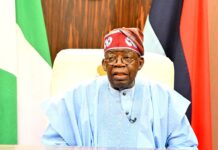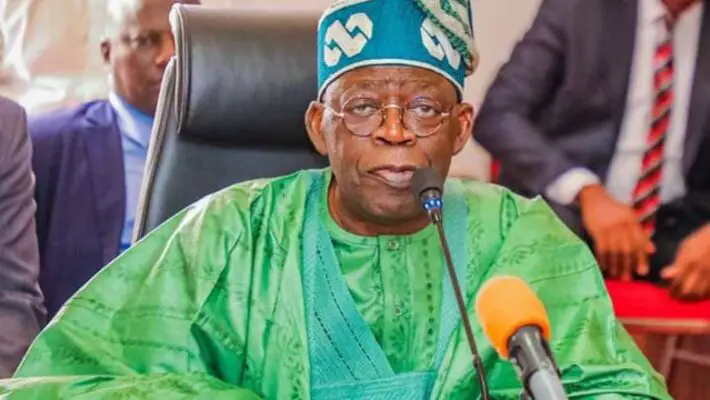





President Bola Tinubu , on Wednesday, closed his defence against the petitions of the presidential candidates of the Labour Party (LP), Peter Obi and that of the Peoples Democratic Party (PDP), Atiku Abubakar.
Atiku and Obi are challenging the legality of Tinubu’s victory before the Presidential Election Petitions Court (PEPC) sitting at the Court of Appeal in Abuja.
The President closed his defence after the testimony of his sole witness, the Senate Majority Leader, Senator Opeyemi Bamidele.
It is important to note that Obi closed his case after calling 13 witnesses that testified and tendered documentary exhibits while Atiku presented 27 witnesses and tendered exhibits before PEPC.
Tinubu commenced the defence of his election victory on Tuesday when he tendered 17 sets of Exhibits, including his educational and travel records.
When the matter came up on Wednesday, Tinubu closed his defence in both Obi and Atiku’s petitions with the testimony of only one witness- Senator Bamidele.
Testifying before PEPC, the star witness, Senator Micheal Opeyemi Bamidele, insisted that votes President Tinubu got in Kano State at the end of the presidential election, was not properly recorded, saying that there was a shortfall of about 10, 929 votes.
Senator Bamidele further told the court that many international bodies that sent observers to the country, including the Economic Community of West African States, ECOWAS, filed a report after the election.
The Senate Leader also informed the court that the ECOWAS report on the presidential election dated February 27, was signed by a former President of Republic of Sierra Leone, Mr. Ernest Koroma.
Despite objection by the lead lawyer to Obi, Dr. Livy Uzoukwu (SAN), the Justice Haruna Tsammani-led five-member panel admitted the ECOWAS report in evidence and marked it as Exhibit RA-27.
Uzoukwu also said his legal team would adduce reasons why they opposed the admissibility of the report in their final written address.
Bamidele further confirmed a letter the LP wrote to INEC on April 25, 2022, wherein it forwarded its membership Register as well as its list of members in Anambra State, to the commission.
Both documents from the LP to INEC were admitted in evidence by the panel and marked as Exhibits RA-17 and RA-18.
Under cross-examination by the lead lawyer to the All Progressives Congress (APC), Prince Lateef Fagbemi (SAN), Bamidele, who said he was the former Chairman of Senate Committee on Judiciary and currently the Majority Leader of the Senate, told the court that the list of membership the LP forwarded to INEC prior to the presidential election, did not contain Obi’s name.
The witness also informed the court that as an Attorney that practiced in United States since 1999, there could not be a criminal conviction against Tinubu when no charge was filed against him.
Bamidele further tendered original documents containing evidence of his membership of the New York Bar in the US.
He said, “As a long standing associate of President Tinubu for over 35 years now, I know that he is a Nigerian citizen by birth.”
But in a counter move, Uzoukwu SAN through the witness, tendered the final report of the European Union (EU) Election Observation Mission to Nigeria, which condemned the conduct and outcome of the 2023 general elections.
Despite objections from lawyers to Tinubu, Vice President Kashim Shettima and the APC (the Respondents), the court admitted a certified copy of the EU report and marked it as Exhibit S-2.
Uzoukwu later asked Bamidele to read a portion of the ECOWAS report which he tendered in evidence, where it stated that there was wanton destruction of properties and killings in the build up to the elections, including the murder of LP’s Senatorial candidate in Enugu State.
After he read the portion, Bamidele said: “My Lords, I do not agree with this aspect. I only accept the conclusion. The killings that were experienced in the South East was due to the IPOB situation and not because of the election.”
Regarding Tinubu’s alleged involvement in drug related crime, Bamidele maintained that contrary to the position of Obi and the LP (the petitioners), he told the court that what was decided by the US Court was a civil proceedings and not a criminal forfeiture.
He urged the court to take a judicial notice of the fact the Obi and the LP anchored their petition on criminal forfeiture whereas the judgment of the US court explicitly stated that the case was a civil matter.
In his testimony in Atiku’s case, Bamidele told PEPC that Tinubu was given a clean bill of health by the United States Embassy in Nigeria.
Under cross-examination by Atiku’s lawyer, Mr. Eyitayo Jegede (SAN), Bamidele admitted that he was neither at the results collation center in Kano nor at the national collation center in Abuja on the day of the presidential election.
He further confirmed that the final results of the presidential election was not signed by any agent of the PDP.
The witness admitted that though Tinubu forfeited the sum of $460, 000 in the US, it was however not in a criminal proceeding.
He also identified the report of the Committee on the location of the Federal Capital Territory (FCT) which he said recommended that Abuja should be specially provided for as the symbol of unity.
Bamidele ,however, insisted that the recommendation did not make the FCT a state.
The Senate Leader also admitted that President Tinubu only got 19.7 per cent votes in the FCT.
When asked if he was aware that Tinubu would be the first person to be declared a President without scoring 25 per cent votes in the FCT, Bamidele told the court that it was not a statutory requirement.
He said, “The requirement is for him to score 25 per cent of total votes cast in the election, not only in the FCT.”
The Senate Leader also acknowledged that of all the four major candidates that contested the presidential candidates, only Tinubu did not win his home state.
He said, “My Lord, it is however not important because he secured the required amount of votes to be declared the winner.”
Meanwhile, lawyers to the Petitioners, through the witness, tendered a copy of November 24, 2022, edition of Vanguard Newspaper, which had a story on APC’s objection to the use of Bimodal Voter Accreditation System (BVAS) machines, for the conduct of the 2023 general elections.
Shortly after, Bamidele was discharged from the witness box, the lead lawyer to Tinubu, Chief Wole Olanipekun (SAN), announced the decision of his client to close his defence at that juncture.
The lead lawyer to the APC, Prince Lateef Fagbemi (SAN), thereafter told the court that it had no witness to present.
He then said, “My Lords, with the evidence of this star witness, we believe that there would be no need to flog an already dead horse”.
Relying on Paragraph 46 of the First Schedule to the Electoral Act, the PEPC consequently directed the Respondents to within 10 days, file their final written address.
It further directed that the Respondents should upon receipt of the Petitioners’ address, file their own final brief of argument within seven days, while the Respondents would file a reply within five days, if they wish to.
The court also warned that whereas all the written addresses should not exceed 40 pages, parties would be at liberty to file separate written addresses not exceeding 10 pages, for all the objections they raised in the course of the hearing.
The court further said the date for adoption of all the processes, preparatory to its final judgement on the case, would be communicated to all the parties.